



Key Findings
● Tourism’s contribution to Ghana’s GDP has increased in recent years, although growth has slowed compared to earlier periods, according to data from the Ghana Tourism Authority.
● Gilma Research estimates that Ghana may be foregoing up to $769 million annually in potential tourism spending due to visa-related travel barriers that discourage spontaneous travel and short-notice visits.
● Ghana has one of the most restrictive entry systems among low to middle-income countries, even for citizens of wealthy nations.
● Tourist spending contributes significantly more to the economy than visa fee revenue, meaning the broader economic value of tourism far outweighs the fiscal gains from visa processing.
● Liberalising entry could increase international arrivals by at least 15.5%, unlocking nearly $21 million in visa fees and $748 million in new tourism spending, which would go to Ghana’s small businesses.
● Ghana historically allowed visa-free access to only about 23 countries, mostly within ECOWAS. While the country has recently expanded visa-free entry to all African passport holders, travellers from most non-African countries still require advance visas, making Ghana less accessible than many competing tourism destinations. Morocco and South Africa provide visa-free or visa-on-arrival access to far more nationalities than Ghana, helping them attract larger volumes of international visitors.
Summary
Tourism has been a key driver of Ghana’s economy, but growth in the sector hasn’t kept pace with that of peer nations. Ghana’s relatively strict visa policies could be holding back its full tourism potential. Ghana’s visa regime, though rooted in national security and reciprocity, is inadvertently costing the country hundreds of millions of dollars in missed economic opportunities.
This research-driven analysis by Gilma Research draws on economic modelling, comparative visa data, and travel trends to assess the cost of Ghana’s current policy and the opportunities that could be unlocked by reform.
The current visa process, which usually requires an advanced visa application, some manual processing, and physical passport mailing, introduces friction that is out of step with modern travel behaviour and even peer-country practices.
In this study, the United States, Ghana’s largest tourism source market, was used as a case study to analyse the bottlenecks and estimate the potential benefits of easing Ghana’s visa and entry requirements.
The findings indicate that even modest reforms to Ghana’s visa regime could yield substantial economic gains. In particular, Ghana’s current visa-on-arrival system is restrictive, as travellers cannot obtain a visa at the port of entry without a pre-approval letter from the Ghana Immigration Service, a requirement that differs from the more flexible visa-on-arrival systems implemented in many other countries. Expanding visa-free access or adopting a fully functional eVisa system could therefore significantly enhance travel demand. These reforms could have generated an estimated additional USD 80 million annually from U.S. travellers alone, and approximately USD 748 million globally, through increased visitor spending and related economic activity.
Countries like Rwanda, Morocco, and Singapore have already demonstrated that visa liberalisation leads to increased tourist arrivals, greater economic benefit and participation, and improved global perception.
Visa policy is more than paperwork; it’s a lever for national income and economic growth.
Methods/ Assumptions
While Ghana’s visa bottlenecks affect travellers from nearly all countries outside ECOWAS, this research uses the United States as a primary case study, given its global economic influence, high travel volume, and strong historical ties to Ghana. The US, which also represents the most lucrative tourism market, is the most affected by current visa restrictions and is likely to face the greatest contrast in travel experience. For comparison, a few African countries considered peers to Ghana were used as a gauge of Ghana’s practices.
II. The Current Visa Regime: A Bottleneck to Potential Economic Growth
Ghana’s current visa regime creates significant barriers for potential travellers regardless of nationality. Citizens of countries outside ECOWAS who can enter Ghana visa-free must download and, until recently, manually complete long visa forms, pay visa fees sometimes through third-party services, pay courier fees, submit passport photos, and mail their passports to a Ghanaian embassy or consulate. The standard process takes 10 to 14 working days, not including 5 to 7 days for courier or mailing. The preparation of the visa application could take 3 to 6 hours.
This multi-step, analogue process discourages not only tourists but also investors, conference speakers, businesspeople, and even diaspora Ghanaians with foreign passports who hope to visit family and friends.
Visa Comparison
The long visa process puts Ghana at a disadvantage when compared to peer destinations. Morocco, for example, offers visa-free entry to U.S. and EU citizens. Potential tourists do not have to fill in any paperwork or go through any application processes. Rwanda offers visa-on-arrival (without restrictions) to nearly all countries, and Kenya processes e-visas within 48 hours. These countries have recognised that easing access leads to higher arrivals, particularly from high-income, high-spending countries.
The United States has been the number one contributor to international arrivals over the past 3 years, with 137,862 arrivals in 2024.
Today, a US citizen can fly to Morocco tomorrow without a visa, but not to Ghana.
Ghana’s restrictive, generally analogue approach makes it hard for last-minute, spontaneous travellers and tourists to visit.
While others issue visas in 48 hours, Ghana still asks travellers to FedEx their passports.
Ghana’s Visa Policies Compared to Leading Economies
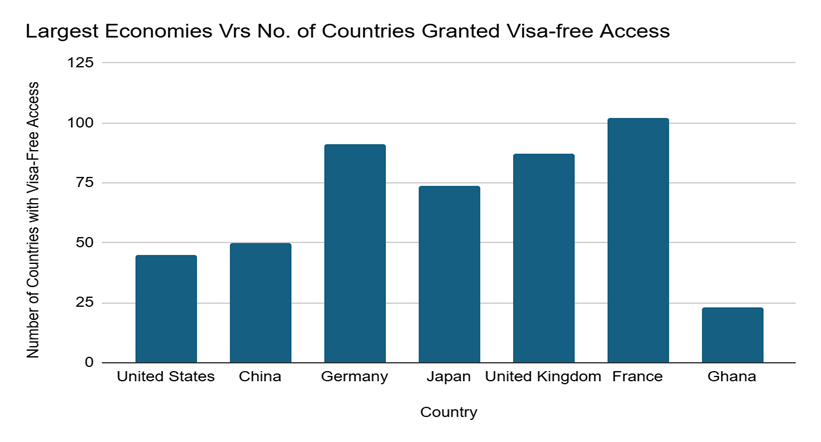
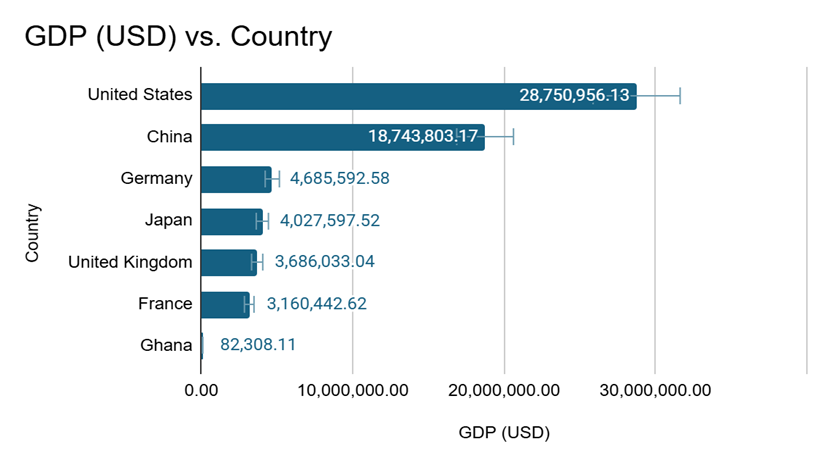
Even large economies with relatively high GDPs have more relaxed visa policies and allow visa-free and visa-on-arrival access to more countries than Ghana.
Ghana’s inability to accommodate spontaneous travel means that visitors choosing between several African destinations are likely to bypass it in favor of simpler options. This visa bottleneck doesn’t just hurt tourism; it sends a message that Ghana is harder to do business with.
Ghana’s Visa Policy Comparison for U.S. Travelers
| Country | Visa Policy for U.S. Travelers | Application Time | Visa Cost | Entry Flexibility |
| Ghana | Visa required (pre-approved) | ~14 days + mailing | $100–$250 | Low (no walk-in travel) |
| Morocco | Visa-free/ e-Visa | None | $0 | Very High |
| Rwanda | Visa on Arrival / e-Visa | 24–48 hours | ~$50 | High |
| Singapore | Visa-free | None | $0 | Very High |
| Egypt | e-Visa or on arrival | ~48 hours | ~$25–$60 | High |
The table above indicates how different select countries approach potential U.S. tourists in terms of ease of access, cost, and flexibility. Among the selected countries, Ghana stands out as the most restrictive, requiring advance visa approval, physical mailing, and processing times of up to 14 days, with costs of up to $200. In contrast, countries like Morocco and Singapore offer visa-free access, while others, such as Rwanda and Egypt, provide faster, more affordable entry options through e-Visas or visas on arrival.
Economy vs Visa Restrictions: Gross National Income (GNI) Per Capita as a Framework
Visa regimes worldwide reflect a delicate balance between openness and protection. Openness here refers to the ease of obtaining visas, including opportunities for visa-free or visa-on-arrival.
For many high-income countries, strict visa controls are considered necessary to manage immigration, protect labour markets, and reduce illegal overstays. Nations such as the United States, Japan, and several EU members have implemented extensive screening processes and reciprocal visa requirements decisions often rooted in the attractiveness of their economies to job seekers, asylum applicants, and long-term migrants.
Citizens of high-income countries tend to have a lower risk of overstaying in low- to medium-income destinations and generally contribute more through tourism spending.
In low- and middle-income countries, the dynamics differ. These countries are not typical destinations for broad economic migration but stand to benefit immensely from attracting short-stay travellers from high-income countries. In such cases, an open visa regime is not a risk but a strategic advantage. The expectation is that low- to medium-income countries will be more open and have fewer restrictions than high-income countries. Countries like Rwanda and Indonesia have recognised this distinction and have adjusted their visa policies to support economic development goals.
Using a comparative table of selected countries across different income brackets, Gilma Research analysed entry accessibility alongside gross national income (GNI) per capita. The expectation is that countries with lower income levels would be more open or accommodating to tourist inflows, and vice versa. With a GNI per capita of just about $2,310, the results place Ghana well below where one would expect it to be, both in terms of absolute visa or entry accessibility and its relative position among economic peers.
GNI per Capita vs Entry Accessibility
| Country | GNI per Capita (USD) | No. of Countries allowed Visa-Free/VoA* |
| Ghana | 2,310 | 23 |
| Nigeria | 1,700 | 17 |
| Rwanda | 1,040 | 23 |
| Morocco | 3,840 | 72 |
| South Africa | 6,110 | 104 |
| UAE | 51,550 | 78 |
| Singapore | 74,750 | 159 |
| USA | 83,490 | 45 |
| Japan | 36,000 | 74 |
| Indonesia | 4,910 | 17 |
*VoA – Visa on arrival
The table above shows that Ghana is less open than nearly all of its peers. Rwanda, at the same Visa-free level, offers a more flexible visa-on-arrival to almost 190 nationalities. Morocco, which is wealthier, grants easy entry to over 72 nationalities and has built a thriving tourism economy as a result. Even Indonesia, another emerging economy with a large population and higher GNI than Ghana, has implemented e-visas, visa-free (17 countries), and flexible (no prior approval) visa-on-arrival systems for over 97 countries. South Africa, one of the top three largest economies in Africa, has 104 countries that come in on a visa-free or visa-on-arrival basis. Even wealthier nations like the UAE and Singapore are more friendly to tourist inflows.
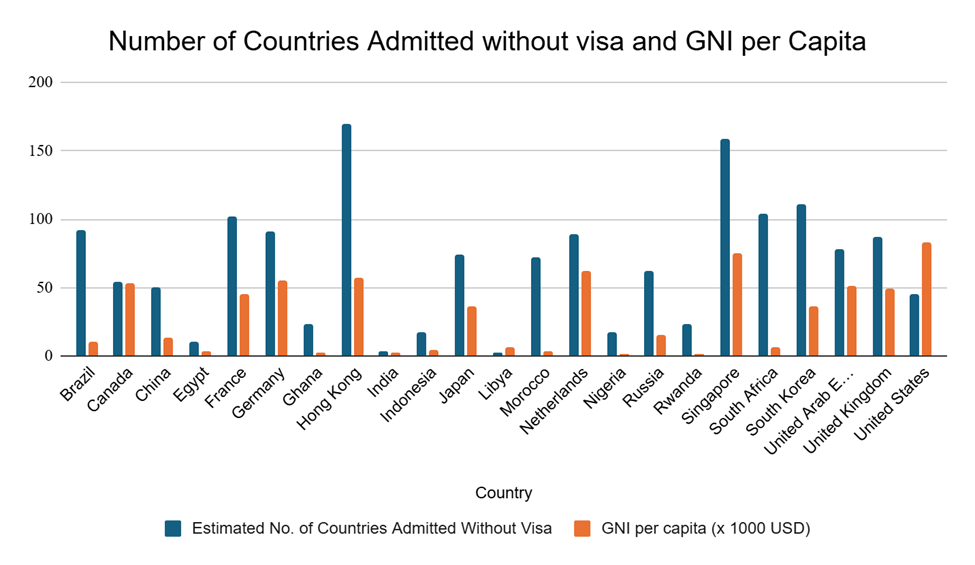
Ghana is more closed than poorer countries and far more closed than countries that compete for the same travelers.
The Gilma Quadrant Approach: Benchmarking Openness Against Economic Standing
To provide further analysis and to illustrate how economic status and visa openness intersect globally, Gilma Research developed a two-axis comparison framework to evaluate the number of countries each select nation allows to enter visa-free and/or through visa-on-arrival, alongside its GNI per capita. This framework allows us to place countries into four quadrants, each reflecting a different strategic posture based on average world income per capita and sample median visa-free and visa-on-arrival.
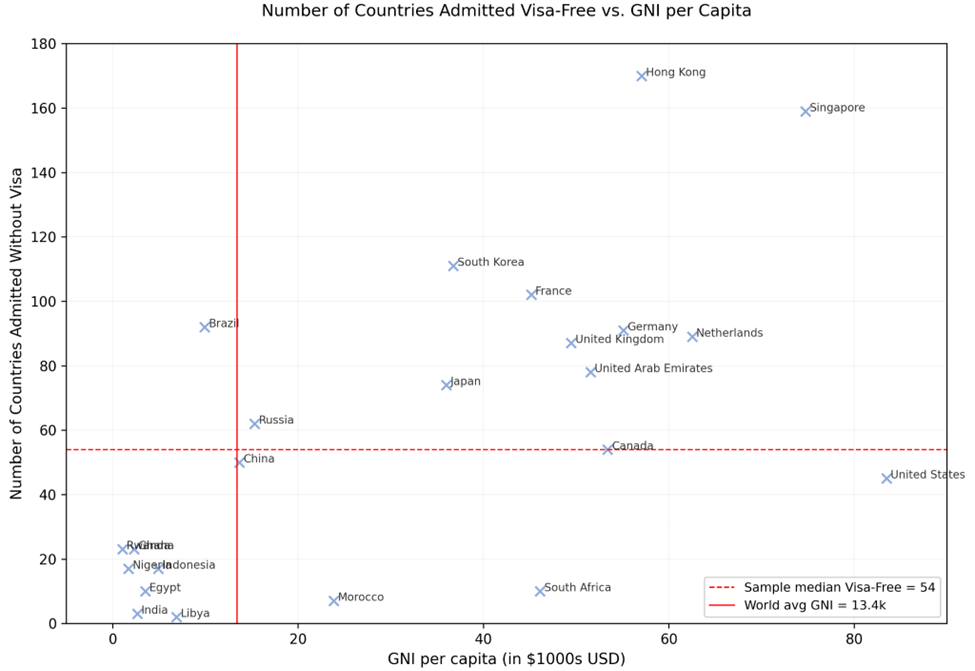
The above graph shows countries and the number of countries it allows to enter visa-free.
As illustrated, Ghana has a modest GNI but a lower visa-free entry. Compared to Hong Kong in the top right quadrant, with a higher GNI but a higher visa fee entry. Quadrant A, in the top left, is composed of low-income countries with many open doors. Quadrant B, on the top right, is for those with higher-than-average income, with many open doors. Quadrant C, bottom left, lower income but closed borders, and quadrant D are higher income with relatively tight doors.
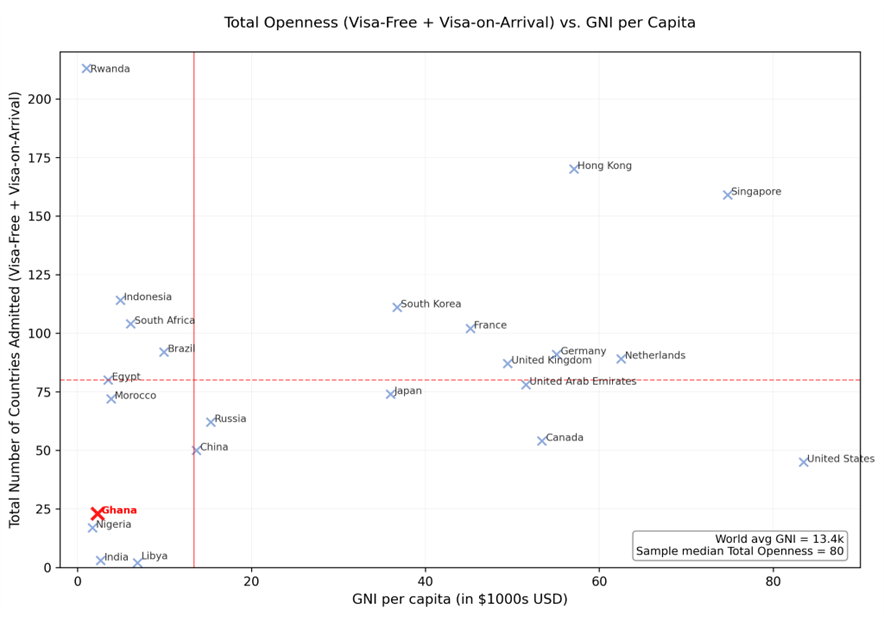
If you add the number of countries with visa-on-arrival to the visa-free count, the graph shifts. Rwanda moved to the top-left due to a dramatic increase in visas on arrival, with the number of countries allowed visa-free rising to 23, plus the number of countries with visa-on-arrival rising to 190, for a total of 213. Singapore, although a high-income country, even has open borders. Ghana still sits at the bottom left with Nigeria, India, and Libya.
This quadrant-based approach reveals that Ghana does not fit the expected pattern of an open, tourism-driven economy. Instead, it behaves like a high-income country in terms of entry restrictions, while reaping only a small share of the protective economic benefits that such restrictions afford wealthier nations.
Ghana’s placement in Quadrant C (low income, low entry accessibility) is both atypical and disadvantageous and economically limiting. In contrast, countries like Rwanda reside in Quadrant A (low income, high openness), while Singapore and the UAE sit comfortably in Quadrant B (high income, high openness), leveraging their entry policies as economic tools to continue to spur economic growth.
“Ghana finds itself in the most limiting position: not rich enough to restrict travel, but too closed to fully benefit from openness.”
The Economics of Restriction – Lost Revenue & Frustrated Tourists
Visa complexity does more than inconvenience travellers; it translates directly into lost revenue. Tourists from high-income countries often have flexible travel budgets and short planning windows. When they encounter friction in entry requirements, they pivot to more accessible destinations. In this economic analysis, Gilma Research used the United States to model the economic impact and scaled it to other countries.
The United States was selected as the reference case because its citizens represent one of the most lucrative tourist segments, with high per-visitor spending and significant potential revenue gains under a more relaxed visa policy.
What Ghana Earns from Visa Fees from US Travelers and What It Could Earn
Visa Receipts from U.S. Tourists: Current Gains vs. Reform Potential
In 2024, Ghana received approximately 137,862 visitors from the United States. Assuming they all applied for the most common single-entry visa at $100, the government collected at least $14.5 million in visa fees. This figure is conservative because multiple-entry and expedited visas incur higher fees.
According to data from the U.S. Embassy, approximately 61,000 Ghanaians applied for U.S. visas in 2024. Using conservative estimates based on standard visa application fees, this translates to an estimated $11.3 million in revenue generated by the U.S. government. In comparison, Ghana earned approximately $14.5 million from visa applications submitted by U.S. travellers. This means that Ghana’s visa revenues were approximately 28% higher than the revenue generated by the U.S.
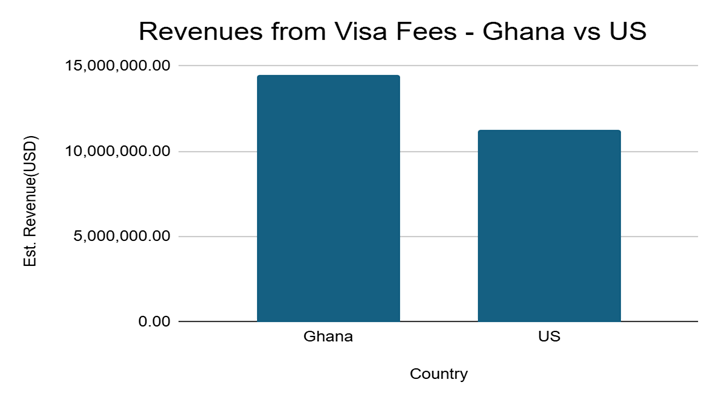
This chart compares the estimated visa fee revenues earned by the governments of Ghana and the United States from each other’s nationals.
Visa Revenue Impact with Visa Openness (Visa on Arrival) – From US Travelers
A policy shift that simplifies travel and provides a more open option, such as visa-on-arrival (without limitation, pre-approval) or streamlined applications, could increase demand.
Research by the World Travel & Tourism Council (WTTC) and Gilma Research’s own modelling shows that relaxing visa requirements can increase tourist arrivals by 15.5%, bringing in an additional 22,493 U.S. visitors.
With a 15.5% increase in applicants achieved under relaxed visa policies, revenues would climb from $14.5 million to $16.8 million, even at the same visa fee.
With the introduction of visa-on-arrival (without pre-approval), which eliminates the burdens of stress, paperwork, passport mailing, and weeks-long processing delays. Ghana could reasonably raise its standard visa fee from $100 to $150 without deterring travellers. Under this scenario, visa fee revenues would rise from the current baseline of $14.5 million to $25.1 million, representing an 73% increase and generating an additional $10.6 million in revenue. This demonstrates the significant fiscal upside of pairing convenience with pricing flexibility.
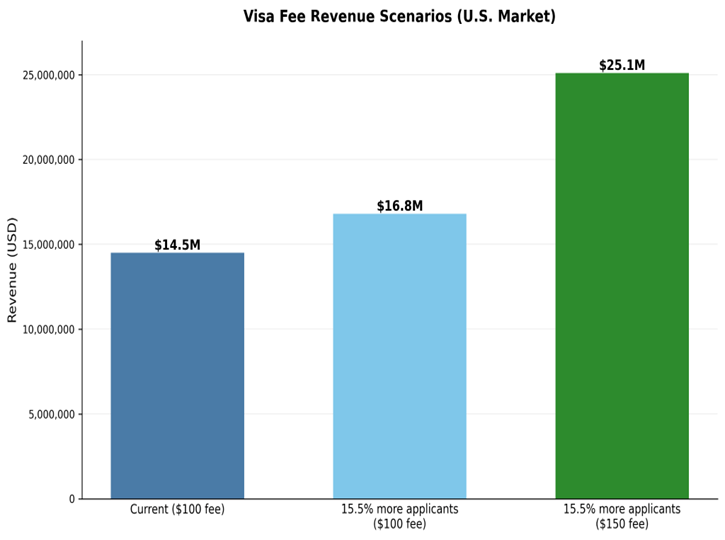
The graph above illustrates annual visa revenue scenarios for Ghana, starting from current collections, then with modest policy adjustments, and finally with a proposed shift to visa-on-arrival (with eased limitations) at a higher fee.
Total Economic Impact with Less Restrictions (US Travelers)
The true economic engine of tourism is not the visa fee or revenue from the visa. It’s what visitors spend once they’re in the country. Gilma Research’s modelling, using tourist expenditures from the sub-region, shows that each tourist spends an average of $3,743 per trip. For the US case, the additional 22,493 tourists who will come in under the visa-on-arrival and visa-free policies will contribute an additional $79.9 million per year to Ghana’s economy.
Most of this spending goes directly to small and medium-sized businesses, hotels, restaurants, taxis, ride-sharing services, bars, craft shops, and cultural attractions. These figures do not account for multiplier effects, such as job creation in the hospitality sector, increased VAT receipts, or repeat business from satisfied travellers.
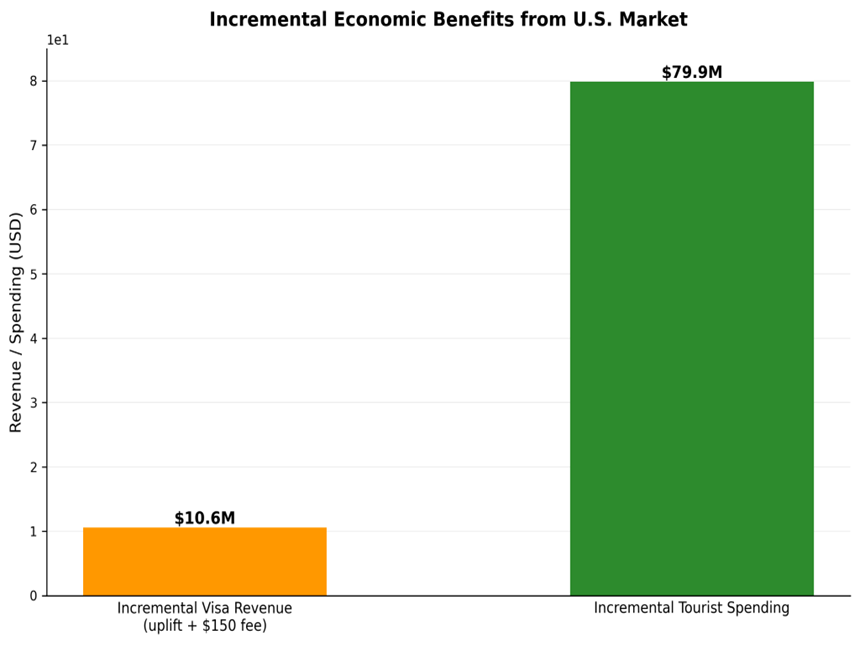
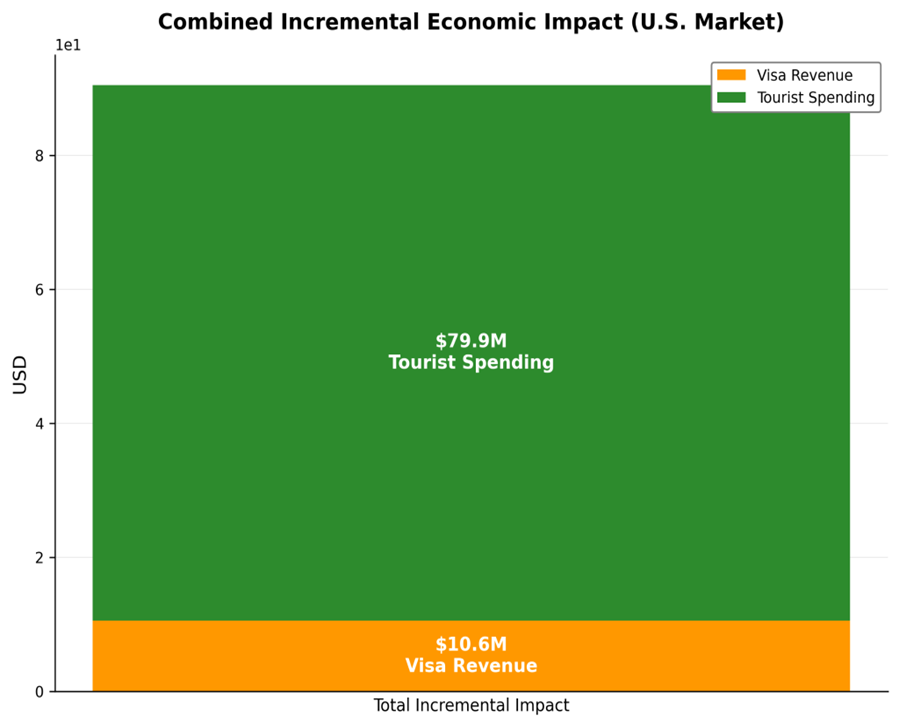
The table above highlights the additional revenue Ghana could generate from U.S. travellers under relaxed visa policies, and compares it to the estimated tourist spending from those same visitors.
At current visa fee levels, tourist spending contributes more than 12 times as much to the economy as visa revenue, approximately $79.9 million in spending versus $10.6 million in fees. While visa fees provide some fiscal value, the primary economic benefit lies in the broader spending by tourists, which far exceeds revenue from visa charges.
This dynamic explains why many countries adopt visa-free or visa-on-arrival regimes, prioritising the broader economic impact of tourism over the relatively modest revenue from visa applications.
Scaling the U.S. Case to All Travelers
The U.S. market provides a useful benchmark to understand the potential gains from visa liberalisation. The total economic impact lies in scaling these results to Ghana’s entire pool of international travellers. International travellers coming to Ghana last year were estimated at 1.29 million.
Using Gilma Research’s models, which draw on global studies from the World Travel & Tourism Council (WTTC) and scenario analysis of Ghana Tourism Authority data, we applied the same 15.5% conservative uplift across all source markets.
- Incremental arrivals from relaxed visa restrictions: ≈ 199,765 additional tourists
- Incremental tourist spending: ≈ $748 million
- Incremental visa revenue: $21 million.
Taken together, Ghana could unlock an annual economic boost of $769 million through higher visa revenues and expanded tourist spending.
As mentioned earlier, this analysis is conservative. It does not include indirect or induced impacts (such as jobs created, supply chain benefits, or multiplier effects). In practice, the overall contribution to GDP could be significantly higher.
A targeted visa-on-arrival policy (without pre-approval limitations) could immediately change this. By allowing travellers from low-risk, high-income countries such as the United States, Canada, the UK, Germany, Japan, and Australia to enter Ghana with payment and documentation upon arrival, the country could significantly boost tourism and business inflows with minimal risk. Countries that have adopted such policies have also introduced premium VoA fees (e.g., $100–$150), which more than offset lost pre-arrival visa revenue.
As other nations liberalise, the competitive gap widens. The global traveller, whether a tourist, investor, or member of the diaspora, has options. If Ghana does not modernise its approach, it risks losing those travellers to friendlier, faster, and more flexible destinations.
Tourism and Employment Impact
Tourism is also an important source of employment in Ghana. Estimates based on data referenced by the World Bank show that the sector supports about 370,000 direct jobs, with the broader tourism economy, when including related sectors such as transportation, hospitality, food supply, and services supporting approximately 813,000 jobs in total. When these figures are compared with Ghana’s 1.29 million international tourist arrivals in 2024, the data suggests that tourism activity sustains a significant number of livelihoods across the economy, reinforcing the sector’s importance as a driver of employment and economic opportunity.
Policy Recommendations
Ghana has a clear opportunity to modernise its visa regime not simply as a procedural update, but as a deliberate economic strategy. Based on the findings presented in this research, the following recommendations are proposed:
1. Accelerate Implementation of Digital Visas and Visa-on-Arrival
The President of Ghana has already directed ambassadors and relevant ministries to work toward an e-visa system. This should be treated not only as a foreign affairs matter but as an economic priority.
We recommend:
- A 30-day visa-on-arrival policy for travellers from all OECD countries and select African partners.
- A global e-visa portal that allows travellers to apply online, upload documents, and receive approval within 48 hours.
- Tiered visa fees, such as $150–$200 for expedited visa-on-arrival, which still compares favourably with current wait-and-mail systems.
Estimated Impact:
These reforms could increase inbound tourism by 15–20%, generating up to $769 million annually in additional spending and visa revenue.
2. Reposition the Visa Regime as an Economic Lever
The current visa policy operates in isolation from Ghana’s economic development goals. We recommend that the Ministry of Finance, the Ministry of Tourism, and the Ghana Investment Promotion Centre (GIPC) be actively involved in any future reform of visa policy. Visa issuance should be evaluated not only for security but also for economic returns.
- Target countries with high-spending outbound travellers (e.g., U.S., U.K., Germany, France, UAE).
- Partner with airlines and travel platforms to promote Ghana as a “visa-easy” destination once changes are implemented.
3. Establish a Visa Liberalisation Review Committee
This inter-ministerial committee would include stakeholders from:
- Ministry of Foreign Affairs
- Ministry of Interior
- Ministry of Tourism
- Ghana Immigration Service
- Private tourism and hospitality sector
The committee’s mandate would be to:
- Monitor visa processing times and traveller drop-off rates
- Report quarterly on progress toward e-visa and visa-on-arrival adoption
- Benchmark against peer African countries and global best practices
4. Design for Diaspora and Dual Citizens
Special arrangements should be made for Ghanaian descendants and diaspora with foreign passports. Many are discouraged by the lengthy visa process and avoid visiting, investing, or hosting events in Ghana as a result.
A simplified path (e.g., automatic visa-on-arrival for those with Ghanaian surnames or family documentation) can be introduced with minimal security risk.