



Abstract
This study examines how politically linked corruption prosecutions in Ghana actually end. Drawing on case files from the Office of the Special Prosecutor (OSP), the Judicial Service of Ghana’s e-Justice case tracking system, the Ghana Legal Information Institute (GhaLII), and reporting from major Ghanaian media houses, we built a defendant level dataset covering 90 defendants across 37 separate cases filed between 2000 and 2026, and classified each outcome as a conviction, an acquittal, a discharge or discontinuation, or a case still pending. The purpose was to move beyond individual news stories and ask, at an aggregate level, whether these prosecutions tend to reach a verdict, and whether the pattern of outcomes lines up with which political party held office when charges were filed. We found that convictions are the exception rather than the rule: only 20% of defendants have been convicted overall, rising to 32% among the cases that have concluded, while 38% remain open. Prison time reliably follows a conviction (94% of convicted defendants received a custodial sentence), but discharge or discontinuation is nearly as common an ending as conviction. Political affiliation is strongly linked to who gets prosecuted in the first place: among the 62 defendants with a stated party affiliation, 85% were charged while a party other than their own held office, and only 15% were charged by a government of their own party. Of that small group prosecuted by their own party, only one case has so far ended in a conviction. In other words, the data are consistent with the common observation that a government in power rarely prosecutes its own people; the great majority of these cases target the opposition. The clearest pattern concerning how cases end relates to timing rather than affiliation: of the 24 defendant cases that were filed under one government and concluded under the next, 71% ended in discharge or discontinuation and only 8% in conviction. These patterns indicate that the fate of a political corruption case in Ghana is tied almost as closely to the electoral calendar, and to who is in office when a case is filed, as to the strength of the evidence against the accused. We recommend measures to insulate prosecutorial decisions from changes in government and to make case outcome data easier for the public to track.
Introduction
Ghana holds regular, competitive elections and has changed the governing party four times since 1992, and each transition has tended to bring a new round of corruption charges against officials of the outgoing administration. Cases like Quality Grain, the Woyome judgment debt affair, and more recently the SML/GRA and buffer stock prosecutions receive heavy news coverage when they are filed, yet coverage of how they eventually end is much thinner. A citizen who reads the headline announcing a new corruption charge rarely sees a follow up story two or five years later reporting a conviction, an acquittal, or a quiet withdrawal.
Ghana’s most recent Transparency International Corruption Perceptions Index score is 43 out of 100, placing it 76th of 182 countries, a score that has been essentially flat since 2015 (Transparency International Ghana, 2026). A flat score alongside a steady stream of high-profile prosecutions raises a natural question: are these cases actually holding people accountable, or are they primarily a feature of political competition that rarely concludes on the merits? This paper does not attempt to answer that question for any single case. Instead, it asks it at the level of the full population of politically linked prosecutions we could identify in the public record, and reports what the pattern of outcomes looks like when the cases are counted rather than read one at a time.
Our objective is descriptive rather than causal. We set out to establish, as precisely as the public record allows, how many politically linked corruption defendants have been convicted, acquitted, or discharged; how long these cases tend to take; and whether outcomes differ depending on which government filed the charges, which government was in office when the case concluded, and the defendant’s own political affiliation. The findings are intended to give policymakers, journalists, and civil society a shared factual baseline for a debate that has so far been conducted mostly through individual, disconnected case reports.
Political and Electoral Context, 2000 to 2026
The prosecutions in this study span seven general elections and five presidential terms held by four individuals. Ghana’s elections fall on a fixed four-year cycle, held every December, with the winner inaugurated the following January. The elections that fall within or immediately before our study period are 2000, 2004, 2008, 2012, 2016, 2020, and 2024. Table A summarizes who held office across that period.
| President | Party | Period in Office | Approx. Duration |
| John Agyekum Kufuor | NPP | 7 January 2001 – 7 January 2009 | 8 years |
| John Evans Atta Mills | NDC | 7 January 2009 – 24 July 2012 (died in office) | 3.5 years |
| John Dramani Mahama (1st term) | NDC | 24 July 2012 – 7 January 2017 | 4.5 years |
| Nana Addo Dankwa Akufo-Addo | NPP | 7 January 2017 – 7 January 2025 | 8 years |
| John Dramani Mahama (2nd term) | NDC | 7 January 2025 – present | 1.5+ years, ongoing |
Table A. Ghana’s presidents and governing parties across the study period, 2001 to 2026. John Dramani Mahama is counted once as an individual but served two non-consecutive terms, elected in 2012 (completing the term of the late President Mills) and again in December 2024, returning to office in January 2025.
Across this period, the presidency changed party five times (Kufuor to Mills in 2009, Mills to Mahama within the same NDC administration in 2012 following Mills’ death, Mahama to Akufo-Addo in 2017, and Akufo-Addo back to Mahama in 2025), and control of government alternated between the NPP and the NDC at every contested election except the 2012 handover within the NDC itself. This regular alternation in power is central to the analysis that follows, since a large share of the prosecutions in our dataset were filed by an incoming government against officials associated with the party it had just replaced.
Literature Review
Ghana’s anti-corruption prosecutions have mostly been documented case by case, in news reporting and in the OSP’s own published case files, rather than tracked as a single body of outcomes. This is a reasonable approach for reporting on any one case, but it makes it hard to see whether the system as a whole is convicting, acquitting, or simply letting cases lapse, and whether that pattern shifts depending on who is in government. Comparable work in other transitional democracies has documented a similar tendency for corruption cases to cluster around changes in political leadership and to lose momentum once the government that filed them leaves office, a pattern often discussed under headings such as selective prosecution or political case attrition, though the extent to which this applies to Ghana specifically had not, to our knowledge, been measured directly.
This study addresses that gap by compiling, to our knowledge for the first time, a single dataset of defendant level outcomes across Ghana’s major politically linked corruption prosecutions since 2000. Rather than adding another single-case account, it contributes an aggregate, countable record that later work, whether academic, journalistic, or institutional, can update and build on.
Methodology
Data Source
The dataset was compiled from public sources in three categories: case files and press releases published by the Office of the Special Prosecutor (osp.gov.gh); official court judgment records from the Judicial Service of Ghana’s e-Justice/e-Judgment system (ejudgment.judicial.gov.gh) and the Ghana Legal Information Institute (ghalii.org), which between them host reported judgments for several of the higher-profile cases in this dataset, including the Tsatsu Tsikata GNPC prosecution and its Supreme Court appeals; and reporting from major Ghanaian and international media houses, including GhanaWeb, Graphic Online, MyJoyOnline, 3News, Citi Newsroom, Modern Ghana, The Herald Ghana, The Ghanaian Times, AllAfrica, and The Africa Report. Each case record was checked against at least one of these sources, and the specific source or sources are recorded against every defendant in the underlying dataset. Not every case produced a reported judgment retrievable on GhaLII or the Judicial Service portal, since a substantial share concluded by discharge or discontinuation rather than by a written verdict; for those, OSP records and media reporting were the primary source.
Sample
The dataset covers 90 defendant level prosecutions across 37 distinct cases, involving 84 distinct individuals (some individuals appear as defendants in more than one case). Cases were included where public reporting identified the defendant as a current or former political office holder, a senior appointee of a state institution, or a private individual charged alongside such an official in the same matter. Charges were filed between 2000 and 2026; outcomes were tracked through August 2026.
Time Period and Analytical Approach
Each defendant record was coded for the government in office when charges were filed, the outcome, the sentence where applicable, and the year the case concluded where a conclusion had been reached. Outcomes were grouped into four categories, Convicted, Acquitted, Discharged or Discontinued, and Ongoing, using the outcome as reported in the source material. Because the source data does not always state which government was in office at the time a case concluded, the government in power at conclusion was inferred from the standard, publicly known dates of Ghana’s administrations (2001 to 2009, 2009 to 2017, 2017 to 2025, and 2025 onward) applied to the year the case concluded. Case duration was calculated in years from the year charges were filed to the year the case concluded, where a clear conclusion date existed; cases still open have no duration value and are excluded from duration averages. All counts and rates were computed using formula driven spreadsheet calculations rather than manual tallying, to allow the analysis to be checked and reproduced.
Results and Findings
Table 1 summarizes the full dataset. The sections that follow present the five findings that most directly answer the study’s research questions, each supported by the underlying counts.
| Metric | Value |
|---|---|
| Distinct cases | 37 |
| Defendant-case instances (defendants x cases) | 90 |
| Distinct individuals prosecuted | 84 |
| Convicted | 18 (20% of all; 32% of concluded) |
| Acquitted | 16 (18% of all; 29% of concluded) |
| Discharged / discontinued | 22 (24% of all; 39% of concluded) |
| Still ongoing (no verdict yet) | 34 (38% of all) |
| Resulted in imprisonment | 17 (94% of those convicted) |
| Average duration, concluded cases | 3.5 years (median 3.5; range 2 months to 7 years) |
| Filed under one government, concluded under another | 24 defendant-cases |
Table 1. Summary statistics for all 90 defendant-case instances in the dataset.
Finding 1: Conviction Is the Exception, Not the Rule
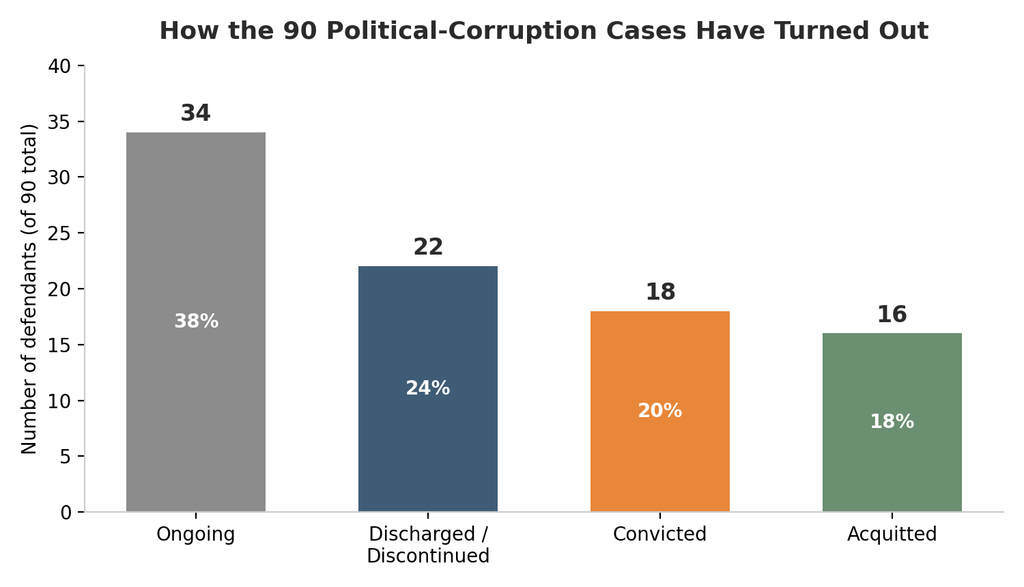
Figure 1. Outcome distribution across all 90 defendant-case instances.
Across all 90 defendant-case instances, 18 (20%) ended in conviction. Because more than a third of the dataset (34 defendants, 38%) is still awaiting a verdict, a fairer comparison looks only at the 56 cases that have actually concluded: even there, convictions account for just 32%, versus 39% that were discharged or discontinued and 29% that were acquitted. Figure 1 shows the full breakdown.
Finding 2: When a Verdict Is Reached, Prison Time Usually Follows, but Verdicts Are Rare
Of the 18 defendants convicted, 17 (94%) received a sentence that included prison time; only one conviction resulted in a fine and restitution without a custodial term. Measured against the full dataset of 90 defendants, however, only 19% have actually served or been sentenced to prison time, since the great majority of cases either have not concluded or concluded without a conviction.
Finding 3: Prosecutions Cluster Heavily Around Whichever Party Just Left Office
Of the 90 defendant-case instances, 53 (59%) were filed while an NPP government was in office and 37 (41%) while an NDC government was in office. The two governments’ case loads look very different in composition: 28 of the 37 NDC-filed instances (76%) are cases opened since the NDC returned to office in January 2025 and remain unresolved, while the NPP-filed instances span a longer period and are mostly concluded. Figure 2 compares outcomes by the government that filed each case.
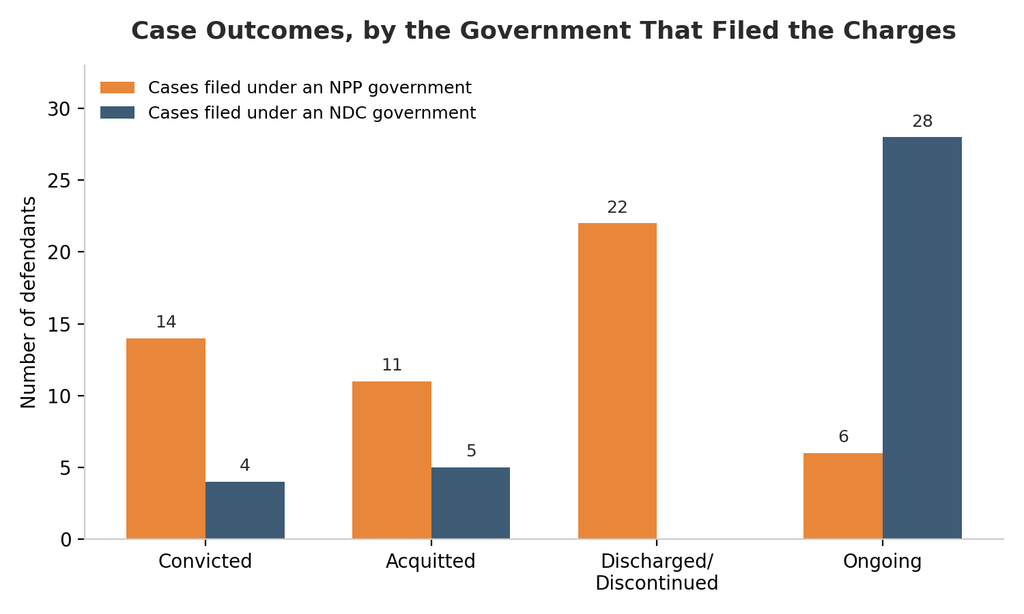
Figure 2. Case outcomes grouped by the government in office when charges were filed.
Finding 4: Conviction Rates Differ by the Defendant’s Own Party, but Recency Matters
Defendants affiliated with the NDC were convicted in 42% of their 31 recorded instances, compared with 37.5% of the 8 instances involving NPP-affiliated defendants (while 22 NPP cases are ongoing). This gap narrows considerably once the underlying case mix is taken into account: 22 of the 30 NPP-affiliated instances (67%) are still open, mostly filed since 2025, so a meaningful share of them have simply not had time to reach a verdict. The 28 instances involving defendants with no stated party affiliation, mainly private businesspeople and civil servants charged alongside officials, show a lower conviction rate still (4%), and a correspondingly higher share of acquittals and discharges.
Finding 5: Cases That Outlive a Change of Government Rarely Reach a Verdict
The clearest pattern in the dataset concerns timing rather than party. Among the 24 defendant-case instances that were filed under one government and concluded only after a different party took office, 71% (17 of 24) ended in discharge or discontinuation, compared with 21% acquitted and just 8% (2 of 24) convicted. Put differently, a political corruption case that survives a change of government in Ghana is, on the evidence so far, far more likely to be quietly dropped than to be decided on the merits either way. Figure 3 shows this breakdown.
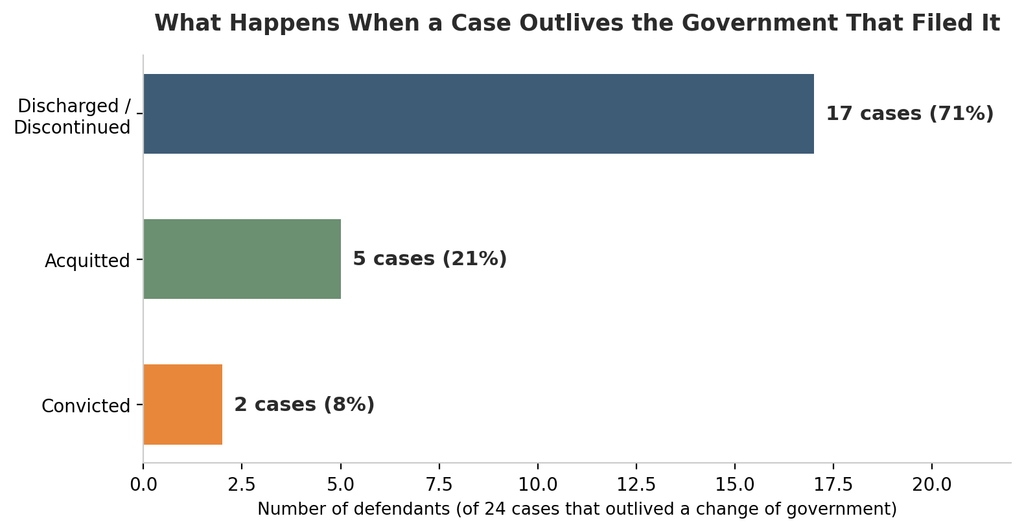
Figure 3. Outcomes among the 24 defendant-case instances that concluded under a different administration than the one that filed the charges.
Finding 6: Governments Rarely Prosecute Their Own, and When They Do, Conviction Is Less Common Than for Opposition-Targeted Cases
A common perception in Ghana holds that a government in power does not prosecute its own people. The dataset supports this perception, both in how often it happens and, once verified case by case, in how those rare self-prosecutions tend to turn out. Restricting the analysis to the 61 defendant-case instances involving a defendant affiliated with one of the two major parties, only 9 (15%) involved a government prosecuting a member of its own party while that party held office; the remaining instances involved a government prosecuting a rival party’s official (51 instances, 84%) or a minor party’s official (1 instance, the Mallam Yussif Ali Issah case, PNC). In other words, for every same-party prosecution in this dataset there are roughly five and a half opposition-targeted ones.
Same-party prosecutions are: Alfred Agbesi Woyome (prosecuted by the NDC government of President Mills in 2011 amid public pressure following an Auditor-General’s report), Abuga Pele, the GYEEDA official prosecuted by the Mahama NDC government in 2014, and five NPP officials charged by the Akufo-Addo NPP government itself: Adjenim Boateng Adjei (PPA scandal, 2022), the four defendants in the NDA/IPEP procurement case (2023), and Cecilia Dapaah and Daniel Osei-Kufour (2023). Two cases that might look like same-party prosecutions at first glance are not, on closer verification. Victor Selormey’s 2000/2001 LEEBDA case is often remembered as an NDC government prosecuting its own, but contemporary court reporting confirms he was arrested in April 2001 and prosecuted through the Fast Track Court under the incoming Kufuor NPP administration (‘the second minister jailed since the Kufuor administration took office’), so this is properly counted as an opposition-targeted case, not a same-party one. Philip Akpeena Assibit, tried alongside Abuga Pele in the GYEEDA case, is a private contractor and CEO of Goodwill International Group rather than an NDC official, so his conviction is counted among non-political defendants rather than among same-party prosecutions.
It is also worth being precise about what the data do, and do not, show about conviction itself. Figure 4 and Table 2 below break the 60 major-party defendant-case instances down by outcome and by whether the government of the day was prosecuting its own party or a rival one. Two things stand out. First, conviction is not something that only happens to the opposition: 1 of the 18 total convictions in this dataset was of a defendant from the governing party itself, prosecuted by its own government, so it does happen, just rarely. Second, same-party prosecutions convict at a distinctly lower rate than opposition-targeted ones: only 1 of 9 same-party instances (11%) has ended in conviction, versus 14 of 51 opposition-targeted instances (27%). The same-party group is dominated by cases that are either still open (5 of 9, 56%) or were discharged (2 of 9, 22%); its single conviction, Abuga Pele, came alongside an acquittal (Woyome) and two discharges (the Cecilia Dapaah case). Given that this is only 9 cases in total, one case either way would shift the same-party conviction rate by more than 10 percentage points, so this comparison should be read as suggestive of a pattern (governments that do prosecute their own tend not to see it through to conviction) rather than as a precise, stable rate.
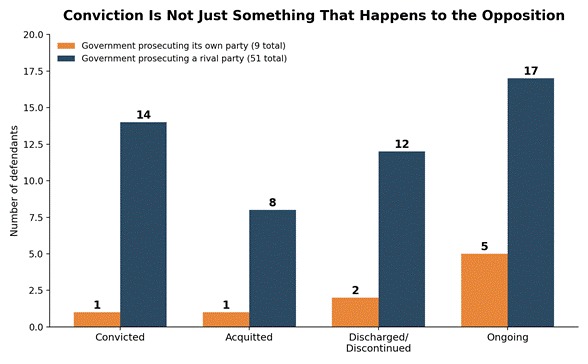
Figure 4. Outcomes for the 60 party-affiliated defendant-case instances (major parties only), split by whether the filing government was prosecuting its own party or a rival party.
| Outcome | Government prosecuting its own party | Share of same-party cases | Government prosecuting a rival party | Share of opposition-party cases |
| Convicted | 1 | 11% | 14 | 27% |
| Acquitted | 1 | 11% | 8 | 16% |
| Discharged / discontinued | 2 | 22% | 12 | 24% |
| Ongoing | 5 | 56% | 17 | 33% |
| Total | 9 | 100% | 51 | 100% |
Table 2. Same-party versus opposition-party prosecutions, by outcome and as a share of each group’s own total.
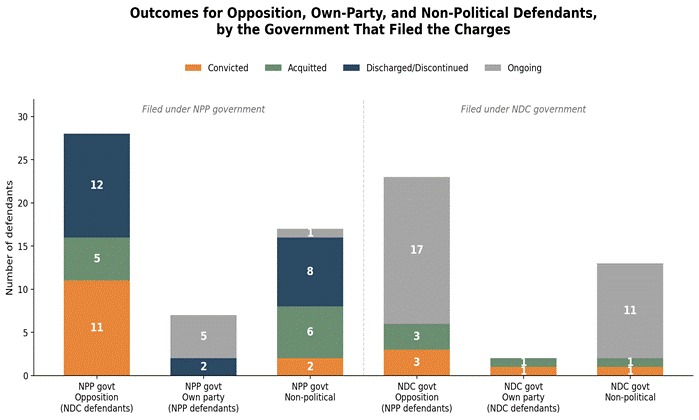
Figure 5. Full outcome breakdown across all 90 defendants, split by the government that filed the charges and by the defendant’s relationship to that government (opposition, own party, or non-political).
Figure 5 breaks this same comparison down one level further, splitting each government’s caseload into opposition-targeted, own-party, and non-political defendants and showing the outcome mix for each. It makes visible a pattern the two-way split can hide: the NPP government’s opposition-targeted cases (filed against NDC officials, 2001-2009 and 2017-2025) are almost entirely resolved, split fairly evenly between conviction, acquittal, and discharge, while its 7 own-party cases have no convictions at all, 2 discharged and 5 still open. The NDC government’s opposition-targeted cases (filed against NPP officials, largely since January 2025) are overwhelmingly still ongoing, reflecting how recent most of them are, while its 2 own-party cases split evenly between one conviction and one acquittal. Non-political co-defendants, private businesspeople and civil servants charged alongside officials, make up the largest single category (30 of 90 defendants) and are the group least likely to be convicted under either government.
Cases Involving a Quantified Financial Loss
The table below shows the list of cases involving financial loss to the state and the original amount reported.
| Case | Year Filed | Amount as Originally Reported |
| SSNIT OBS ($66m Software) Case | 2018 | US$66,000,000 |
| NPA Extortion Case | 2025 | ~GH₵280,000,000 |
| Microfinance and Small Loans Centre (MASLOC) Scandal | 2019 | GH₵90,000,000 |
| National Signals Bureau Cyber-Defence Fraud Case | 2025 | GH₵49,100,000 (~US$7,000,000, as reported) |
| NSA Ghost Names Scandal | 2025 | GH₵31,500,000 |
| National Communications Authority (NCA) Scandal | 2018 | US$4,000,000 |
| GYEEDA Scandal Case | 2014 | GH₵4,100,000 |
| LEEBDA / Court Computerisation Case | 2000 | US$1,297,500 |
| Wontumi Samreboi Illegal Mining Case | 2025 | GH₵120,000 (fine) |
| Galamsey Licence Bribery Case | 2025 | GH₵35,000 (bribe); GH₵200,000 restitution; GH₵6,000 fine |
| Mallam Yussif Ali Issah Case | 2001 | US$46,000 |
| Tsatsu Tsikata Case | 2002 | GH₵230,000 |
| Quality Grain Case | 2001 | $20,000,000 |
| TIP / Science Park Case | 2002 | $400,000 |
| Woyome Judgment Debt Case | 2011 | GH₵51,200,000 |
| COCOBOD / Lithovit Case | 2018 | GH₵271.3M |
| UT Bank Collapse Case | 2020 | GH¢100 million (Amoabeng, depositor funds) + GH¢460 million (Asiama/Amanfu, unauthorized liquidity support) + GH¢51.3m/$8.8m (vehicle-investment transfer) |
| UniBank Collapse Case | 2020 | GH¢5.7 billion total shareholder debt (KPMG audit); GH¢663.28m specifically charged to Duffuor; GH¢300m charged to Asiama |
| Ambulance Trial Case | 2019 | €2.37M |
| Saglemi Housing Case | 2021 | $200M |
| Ofori-Atta / SML-GRA Case | 2025 | GH₵1.4B |
| PPA Scandal Case | 2022 | GH¢41M |
| NDA / IPEP Procurement Case | 2023 | Contract inflated from GH¢5.72M to GH¢10.4M (~GH¢4.68m unauthorized increase); ~GH¢8.3M actually paid |
| National Signals Bureau Cyber-Defence Fraud Case | 2025 | GH¢49.1 M |
| Bawku Landcruiser Case (Ayariga II) | 2019 | GH¢120,000 (3 vehicles sold at GH¢40,000 each) + ~GH¢30,528 evaded tax |
| Nsawam Cannery Divestiture Case | 2006 | ¢2.789 billion to ¢2.9 billion in old Ghana cedis |
| GREL Divestiture Case | 2001 | |
| Buffer Stock / NAFCO Scandal | 2025 | GH¢78.2M (original Oct 2025 charge); revised to GH¢62.6 million in fresh May 2026 charges |
| SkyTrain / GIIF Case | 2025 | $2M |
| Wontumi EXIM Bank Loan Fraud Case | 2026 | GH¢30M |
| Ghana@50 Case | 2010 | Total Expenditure: GH¢97,776,338, Approved Budget: GH¢29.31 M |
| Information Ministry Renovation Case (‘Asabee’) | 2009 | GH¢86,915.85 |
The dollar-denominated cases are worth reading with the year in mind. LEEBDA’s $1,297,500 refund order, for instance, was a very large sum in 2001 Ghana, equivalent to roughly ₵9.3 billion in the old cedi then in circulation. The SSNIT and NCA figures, both tied to 2018, convert to roughly GH₵323 million and GH₵20 million respectively at that year’s exchange rate; converting them at today’s much weaker cedi would overstate their value at the time the alleged loss occurred, which is why we anchored the conversion to the filing year throughout.
Discussion
- Taken together, these findings suggest that political transitions, rather than the strength of the evidence alone, are strongly associated with how Ghana’s political corruption cases end, and even with who gets charged in the first place. The affiliation numbers reported in the abstract bear repeating here: among the 62 defendants in our dataset with a stated party affiliation, 53 (85%) were charged while a different party held government, and only 9 (15%) were charged by a government of their own party. Of those 9, only one, the GYEEDA case against Abuga Pele, has so far ended in a conviction; the rest are either still ongoing or ended in acquittal or discharge. This is consistent with the common observation in Ghanaian public life that a government in power rarely goes after its own people with the same intensity it applies to the opposition, though our data describe the pattern rather than any single administration’s motives for it.
- The pattern in Finding 5 is the most striking on the question of how cases end. Cases that outlive the government that filed them are heavily concentrated in the discharged or discontinued category rather than in either verdict outcome. This is consistent with, though it does not on its own prove, an account in which each incoming Attorney General’s office reviews the prior government’s cases and drops a large share of them rather than pursuing them through to a verdict.
- There are other explanations worth weighing alongside that one. Some discharged cases may reflect genuine evidentiary weaknesses that only become apparent once new prosecutors review the file, rather than political convenience. Court backlogs and the slow pace of Ghana’s justice system more broadly (the average concluded case in this dataset took three and a half years) could also mean that some of the discharged cases were simply abandoned for practical, resource-related reasons rather than a deliberate political decision. Distinguishing between these explanations would require case-by-case reasoning review that goes beyond what a public outcome dataset can show, and is a natural next step for follow-up research.
- The affiliation gap in Finding 4 should be read cautiously for a related reason: a large share of the NPP-affiliated instances are recent cases filed since the 2025 transition and have simply not had time to reach a verdict. As those cases resolve over the next few years, the comparison in Finding 4 may look quite different, and the dataset underlying this report is designed to be updated as that happens.
- For public trust in anti-corruption institutions, both readings of the data point toward the same practical concern. Whether cases are dropped for political reasons or for resource reasons, a system in which most politically linked corruption charges never reach a verdict, and in which the choice of who gets charged already tilts heavily toward the opposition, makes it hard for citizens to know whether accountability is actually happening. It leaves prosecutions vulnerable to the perception that they function more as a tool of political competition than as even-handed law enforcement.
Limitations
- Scope limitations: this study only includes matters where formal criminal charges were filed before a court. It excludes defamation and libel suits, publication-of-false-news charges, and other press-related offences, even where these involved politicians or public officials, because they are not corruption prosecutions in the sense this study is concerned with. It also excludes corruption allegations that were investigated by the OSP, the police, or a commission of inquiry but never resulted in a formal charge being filed in court, since there is no court record to track an outcome against. A separate study focused specifically on defamation cases or on investigations that stalled before charging would answer a different, also useful, question.
- Data limitations: the dataset relies on cases visible in OSP records, the Judicial Service’s e-Justice system, GhaLII, and major media coverage; smaller or less-publicized political corruption cases may be underrepresented, and some outcomes reported by media (particularly recent discharges and plea negotiations) may be revised as court records catch up.
- Sampling limitations: this is not a random or complete sample of all corruption allegations in Ghana, only those that reached formal charges and received public documentation; it therefore describes the population of publicly visible political prosecutions, not corruption in Ghana as a whole.
- Geographic and scope limitations: the dataset covers national-level prosecutions in Ghana’s courts and the OSP; it does not include internal party disciplinary actions, civil asset-recovery proceedings that were not paired with a criminal charge, or purely administrative sanctions.
- Methodological limitations: the four-category outcome classification simplifies some more complex real-world dispositions (for example, a conviction later reversed on appeal is coded by its final recorded status); the government in office at a case’s conclusion is inferred from the year concluded rather than the exact date, which is an approximation for cases that concluded in a transition year; case duration for a small number of entries relied on approximate ranges reported in the source material rather than exact dates; and the Ghana cedi equivalents in Table 2 rely on annual average exchange rate estimates for the year charges were filed rather than exact daily rates, so should be read as indicative rather than precise.
Recommendations
- Publish a standardized, public case tracker. The Office of the Special Prosecutor and the Attorney General’s Department should maintain and regularly update a single public database of case status, covering filing date, current stage, and outcome, so that the pattern shown in this report can be monitored in real time rather than reconstructed after the fact.
- Require public justification for post-transition discharges. Given that 71% FF of cases surviving a change of government end in discharge, Parliament and the Attorney General’s Department should consider a rule requiring any decision to discontinue a case after a change of administration to be accompanied by a public, written justification reviewable by the courts.
- Set case-management benchmarks to reduce delay. The Judicial Service of Ghana should set target timelines for corruption trials, given that concluded cases in this dataset took an average of three and a half years and some took considerably longer, since delay itself increases the chance a case will outlive the government that filed it.
- Maintain independent, cross-referenced outcome tracking. Civil society organizations and media houses should maintain a shared, continuously updated record of case outcomes rather than one-off reporting at the point charges are filed, since this project found that assembling even a basic outcome record currently requires manually cross-referencing dozens of separate news reports.
- FReport conviction and duration statistics by affiliation. Parliament’s Public Accounts Committee or an equivalent oversight body should periodically publish conviction and case-duration statistics disaggregated by the defendant’s political affiliation and by the government that filed the case, to allow the public to monitor for any appearance of selective enforcement over time.
References
Office of the Special Prosecutor, Republic of Ghana. Case Files and Press Releases. Retrieved from osp.gov.gh.
Judicial Service of Ghana. e-Justice Case Tracking and e-Judgment System. Retrieved from ejudgment.judicial.gov.gh. Consulted for judgment records on cases including the Tsatsu Tsikata GNPC prosecution and its related Supreme Court rulings.
Ghana Legal Information Institute (GhaLII). Judgment Database. Retrieved from ghalii.org. Consulted for reported judgments including Tsikata v Republic and related appellate decisions; not every case in the dataset was independently located on this platform, since several concluded by discharge or discontinuation before producing a reported judgment.
Transparency International Ghana. (2026). Ghana’s 2025 Corruption Perceptions Index Result: 43/100, Ranked 76th of 182 Countries. Press Statement.
International Monetary Fund, International Financial Statistics, via Federal Reserve Bank of St. Louis (FRED). Ghana Official Exchange Rate, National Currency per US Dollar. Used for the 2001 exchange rate estimate in Table 2.
Central Intelligence Agency. The World Factbook, Exchange Rates (2021 archive). Used for the 2018 exchange rate estimate in Table 2.
Compiled case reporting, 2001 to 2026, from GhanaWeb, Graphic Online, MyJoyOnline, 3News, Citi Newsroom, Modern Ghana, The Herald Ghana, The Ghanaian Times, AllAfrica, and The Africa Report, as itemized against each defendant in the project dataset.
Appendix A: Full Defendant-Level Dataset
The table below lists all 90 defendant-case instances underlying this report, in the order they appear in the project dataset. Political affiliation, court, sentence, and source details for each entry are available in the companion spreadsheet.
| Case | Defendant | Affiliation | Filed | Outcome | Concluded |
|---|---|---|---|---|---|
| Quality Grain Case | Kwame Peprah | NDC | 2001 | Convicted | 2003 |
| Quality Grain Case | Ibrahim Adam | NDC | 2001 | Convicted | 2003 |
| Quality Grain Case | George Sipa-Adjah Yankey | NDC | 2001 | Convicted | 2003 |
| Quality Grain Case | Nana Ato Dadzie | NDC | 2001 | Acquitted | 2003 |
| Quality Grain Case | Samuel Dapaah | NDC | 2001 | Acquitted | 2003 |
| Quality Grain Case | Kwesi Ahwoi | NDC | 2001 | Discharged/Discontinued | N/A – discontinued |
| LEEBDA / Court Computerisation Case | Victor Selormey | NDC | 2000 | Convicted | 2001 |
| TIP / Science Park Case | Dan Abodakpi | NDC | 2002 | Convicted | 2007 |
| Woyome Judgment Debt Case | Alfred Agbesi Woyome | NDC | 2011 | Acquitted | 2016 |
| COCOBOD / Lithovit Case | Dr. Stephen Kwabena Opuni | NDC | 2018 | Discharged/Discontinued | 2025 |
| COCOBOD / Lithovit Case | Seidu Agongo | Not a political appointee | 2018 | Discharged/Discontinued | 2025 |
| Wontumi Samreboi Illegal Mining Case | Bernard Antwi-Boasiako (Chairman Wontumi) | NPP | 2025 | Convicted | 2026 |
| GYEEDA Scandal Case | Philip Akpeena Assibit | NDC | 2014 | Convicted | 2018 |
| National Communications Authority (NCA) Scandal Case | Eugene Baffoe-Bonnie | NDC | 2018 | Convicted | 2020 |
| National Communications Authority (NCA) Scandal Case | William Matthew Tetteh Tevie | NDC | 2018 | Convicted | 2020 |
| National Communications Authority (NCA) Scandal Case | Alhaji Salifu Mimina Osman | NDC | 2018 | Convicted | 2020 |
| Microfinance And Small Loans Centre (MASLOC) Scandal Case | Sedina Christine Tamakloe-Attionu | NDC | 2019 | Convicted | 2024 |
| Microfinance And Small Loans Centre (MASLOC) Scandal Case | Daniel Axim | NDC-affiliated appointee | 2019 | Convicted | 2026 |
| Tsatsu Tsikata Case | Tsatsu Tsikata | NDC | 2002 | Convicted | 2008 |
| Mallam Yussif Ali Issah Case | Mallam Yussif Ali Issah | PNC | 2001 | Convicted | 2001 |
| UT Bank Collapse Case | Johnson Pandit Asiamah (Dr) | NDC | 2020 | Discharged/Discontinued | 2025 |
| UT Bank Collapse Case | Prince Kofi Amoabeng | Not a political appointee | 2020 | Discharged/Discontinued | 2025 |
| UniBank Collapse Case | Kwabena Duffuor (Dr) | NDC | 2020 | Discharged/Discontinued | 2025 |
| UniBank Collapse Case | Kwabena Duffuor II (Dr) | NDC | 2020 | Discharged/Discontinued | 2025 |
| Ambulance Trial Case | Cassiel Ato Forson | NDC | 2019 | Acquitted | 2025 |
| Ambulance Trial Case | Richard Jakpa | Not a political appointee | 2019 | Acquitted | 2025 |
| Saglemi Housing Case | Collins Dauda (Alhaji) | NDC | 2021 | Discharged/Discontinued | 2025 |
| Saglemi Housing Case | Kwaku Agyemang-Mensah (Dr) | NDC | 2021 | Discharged/Discontinued | 2025 |
| Saglemi Housing Case | Ziblim Yakubu (Alhaji) | Not a political appointee | 2021 | Discharged/Discontinued | 2025 |
| Saglemi Housing Case | Nouvi Tetteh Angelo | Not a political appointee | 2021 | Discharged/Discontinued | 2025 |
| Saglemi Housing Case | Andrew Clocanas (deceased) | Not a political appointee | 2021 | Discharged/Discontinued | 2025 |
| Ofori-Atta / SML-GRA Case | Kenneth Nana Yaw Ofori-Atta | NPP | 2025 | Ongoing | Ongoing |
| Ofori-Atta / SML-GRA Case | Ernest Akore | NPP | 2025 | Ongoing | Ongoing |
| Ofori-Atta / SML-GRA Case | Col. (Rtd) Kwadwo Damoah | NPP | 2025 | Ongoing | Ongoing |
| Ofori-Atta / SML-GRA Case | Emmanuel Kofi Nti | NPP | 2025 | Ongoing | Ongoing |
| Ofori-Atta / SML-GRA Case | Ammishaddai Owusu-Amoah | NPP | 2025 | Ongoing | Ongoing |
| NPA Extortion Case | Mustapha Abdul-Hamid | NPP | 2025 | Ongoing | Ongoing |
| PPA Scandal Case | Adjenim Boateng Adjei | NPP | 2022 | Ongoing | Ongoing |
| Galamsey Licence Bribery Case | Charles Bissue | NPP | 2025 | Ongoing | Ongoing |
| Galamsey Licence Bribery Case | Andy Thomas Owusu | NPP | 2025 | Convicted | 2025 |
| NDA / IPEP Procurement Case | Sumaila Abdul-Rahman | NPP | 2023 | Ongoing | Ongoing |
| NDA / IPEP Procurement Case | Stephen Yir-Eru Engmen | NPP | 2023 | Ongoing | Ongoing |
| NDA / IPEP Procurement Case | Patrick Seidu | NPP | 2023 | Ongoing | Ongoing |
| NDA / IPEP Procurement Case | Andrew Kuundaari | NPP | 2023 | Ongoing | Ongoing |
| Cecilia Dapaah Cash-at-Residence Case | Cecilia Abena Dapaah | NPP | 2023 | Discharged/Discontinued | 2024 |
| Cecilia Dapaah Cash-at-Residence Case | Daniel Osei-Kufour | NPP | 2023 | Discharged/Discontinued | 2024 |
| National Signals Bureau Cyber-Defence Fraud Case | Mildred Boateng | Not a political appointee | 2025 | Ongoing | Ongoing |
| Bawku Landcruiser Case (Ayariga II) | Mahama Ayariga | NDC | 2019 | Discharged/Discontinued | 2021 |
| Bawku Landcruiser Case (Ayariga II) | Kenerick Akwasi Marfo | Not a political appointee | 2019 | Discharged/Discontinued | 2021 |
| GACL Revenue-Assurance Case | Paul Adom-Otchere | NPP | 2025 | Ongoing | Ongoing |
| Tema Port Fake VP-Office Letter Rice Case | Issah Seidu | Not a political appointee | 2025 | Ongoing | Ongoing |
| Tema Port Fake VP-Office Letter Rice Case | James Keck Osei | NPP | 2025 | Ongoing | Ongoing |
| Tema Port Fake VP-Office Letter Rice Case | John Abban | Not a political appointee | 2025 | Ongoing | Ongoing |
| Tema Port Fake VP-Office Letter Rice Case | Peter Archibold Hyde | Not a political appointee | 2025 | Ongoing | Ongoing |
| NSA Ghost Names Scandal | Osei Assibey Antwi | NPP | 2025 | Ongoing | Ongoing |
| NSA Ghost Names Scandal | Gifty Oware-Mensah | NPP | 2025 | Ongoing | Ongoing |
| Nsawam Cannery Divestiture Case | Nana Konadu Agyeman-Rawlings | NDC | 2006 | Discharged/Discontinued | 2009 |
| Nsawam Cannery Divestiture Case | Sherry Ayittey | NDC | 2006 | Discharged/Discontinued | 2009 |
| Nsawam Cannery Divestiture Case | Kwame Peprah | NDC | 2006 | Discharged/Discontinued | 2009 |
| Nsawam Cannery Divestiture Case | Emmanuel Amuzu Agbodo | Civil servant/appointee | 2006 | Discharged/Discontinued | 2009 |
| Nsawam Cannery Divestiture Case | Thomas Benson Owusu | Civil servant/appointee | 2006 | Discharged/Discontinued | 2009 |
| GREL Divestiture Case | Sherry Ayittey | NDC | 2001 | Acquitted | 2005 |
| GREL Divestiture Case | Emmanuel Amuzu Agbodo | Civil servant/appointee | 2001 | Acquitted | 2005 |
| GREL Divestiture Case | Ralph Casely-Hayford | Not a political appointee | 2001 | Convicted | 2005 |
| GREL Divestiture Case | Sati Dorcas Ocran | Not a political appointee | 2001 | Acquitted | 2003 |
| Buffer Stock / NAFCO Scandal | Hanan Abdul-Wahab | NPP | 2025 | Ongoing | Ongoing |
| Buffer Stock / NAFCO Scandal | Faiza Seidu Wuni | Not a political appointee | 2025 | Ongoing | Ongoing |
| SkyTrain / GIIF Case | Solomon Asamoah | NPP | 2025 | Ongoing | Ongoing |
| SkyTrain / GIIF Case | Prof. Christopher Ameyaw-Akumfi | NPP | 2025 | Ongoing | Ongoing |
| Wontumi Samreboi Illegal Mining Case | Bernard Antwi Boasiako (Chairman Wontumi) | NPP | 2025 | Convicted | 2026 |
| Wontumi EXIM Bank Loan Fraud Case | Bernard Antwi Boasiako (Chairman Wontumi) | NPP | 2026 | Ongoing | Ongoing |
| Wontumi EXIM Bank Loan Fraud Case | Thomas Antwi Boasiako | Not a political appointee | 2026 | Ongoing | Ongoing |
| Wontumi Tano Nimiri Forest Reserve Case | Bernard Antwi Boasiako (Chairman Wontumi) | NPP | 2025 | Ongoing | Ongoing |
| Wontumi Tano Nimiri Forest Reserve Case | Kwame Antwi | Not a political appointee | 2025 | Ongoing | Ongoing |
| Wontumi Tano Nimiri Forest Reserve Case | Owusu Bempah | Not a political appointee | 2025 | Ongoing | Ongoing |
| Wontumi Tano Nimiri Forest Reserve Case | Edward Akuoko | Not a political appointee | 2025 | Ongoing | Ongoing |
| National Signals Bureau Cyber-Defence Fraud Case | Kwabena Adu-Boahene | Not a political appointee | 2025 | Ongoing | Ongoing |
| National Signals Bureau Cyber-Defence Fraud Case | Angela Adjei-Boateng | Not a political appointee | 2025 | Ongoing | Ongoing |
| GYEEDA Scandal Case | Abuga Pele | NDC | 2014 | Convicted | 2018 |
| UniBank Collapse Case | Kwabena Duffuor | NDC | 2020 | Discharged/Discontinued | 2025 |
| Ghana@50 Case | Charles Wereko-Brobbey | NPP | 2010 | Acquitted | 2011 |
| Ghana@50 Case | Kwadwo Okyere Mpiani | NPP | 2010 | Acquitted | 2011 |
| Information Ministry Renovation Case (‘Asabee’) | Stephen Asamoah-Boateng | NPP | 2009 | Acquitted | 2014 |
| Kotoka Airport BNI Obstruction Case | Zuleika Jennifer Lorwia | Not a political appointee | 2009 | Acquitted | 2010 |
| Kenneth Ofori-Atta OSP Investigations (general reference) | Kenneth Nana Yaw Ofori-Atta | NPP | 2025 | Ongoing | Ongoing |
| SSNIT OBS ($66m Software) Case | Ernest Thompson (Dr) | NDC-affiliated appointee | 2018 | Acquitted | 2025 |
| SSNIT OBS ($66m Software) Case | John Hagan Mensah | Not a political appointee | 2018 | Acquitted | 2025 |
| SSNIT OBS ($66m Software) Case | Peter Hayibor | Not a political appointee | 2018 | Acquitted | 2025 |
| SSNIT OBS ($66m Software) Case | Juliet Hassana Kramer | Not a political appointee | 2018 | Acquitted | 2024 |
| SSNIT OBS ($66m Software) Case | Caleb Kwaku Afaglo | Not a political appointee | 2018 | Ongoing | Ongoing |