



The Daily Commute Crisis
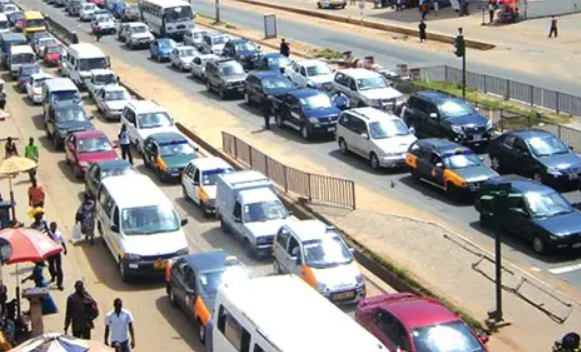
Every morning, Afia sets off from Madina hoping to reach her office in Ridge by 8 a.m., but her journey is anything but predictable. What should take just 30 minutes often stretches into a frustrating 90-minute ordeal. Her story is far from unique. Multiply Afia’s experience by the number of commuters travelling in and out of Accra every day, and the scale of the problem quickly becomes undeniable.
What seems like a mere transportation inconvenience is, in fact, a growing economic emergency. Accra’s traffic is more than a nuisance; it is a massive economic sinkhole that quietly drains productivity, income, and quality of life. And this crisis is not static; it is escalating. As Ghana’s urban population continues to rise, especially in key areas, so too will the number of vehicles, the hours lost to congestion, and the economic damage inflicted by traffic paralysis.
The combination of new residential developments, population growth, and the concentration of jobs in the urban core means more people will be making longer, slower commutes unless something changes. If current trends continue unchecked, we are not just looking at congestion; we are looking at a future where daily gridlock becomes normalized, so much so that it is built into how we plan our lives and businesses. This research delves into the numbers behind congestion along the Adenta–Accra corridor, with a particular focus on the Madina–37 stretch. It examines the measurable economic losses Ghana incurs daily due to this bottleneck, and more importantly, what the nation stands to gain, both economically and socially by addressing it head-on.
Ghana is silently losing over GHS 400 million a year on just the Madina – 37 stretch.

The Numbers Behind the Pain
Traffic congestion along the Madina–37 corridor may appear as a daily inconvenience, but behind the chaos lies a complex web of economic loss. From wasted hours and drained productivity to excess fuel consumption and mounting national costs, the impact is wide and deeply embedded in our economy. These aren’t just theoretical numbers; they represent missed opportunities, stunted growth, and money quite literally burned. In the following breakdown, we quantify the specific ways this single corridor is silently siphoning value from Ghana’s workforce, its fuel reserves, and its future.
Time lost to traffic
During peak traffic hours, from 6:30 to 9:30 in the morning and 4:30 to 7:30 in the evening, approximately 7,200 vehicles pass through the narrow Madina–37 road daily. This is not just a stream of cars; it’s a rolling delay that stifles movement, bleeds fuel, and stretches everyone’s patience. These vehicles are primarily salon cars, vans, or buses, carrying more than 34,000 people every day during the peak period. Every one of those people is losing time that could be spent working, studying, parenting, resting, or even sleeping to refresh for the next day. It’s also time that could be spent contributing to the local economy: eating at small restaurants, patronizing local shops, or running a side hustle. In short, this is not just lost time, it’s lost opportunity at every level.
2
Hours Lost Daily
Per Commuter
GHS 32.42
Daily Cost
Per person at Ghana’s Average hourly wage of GHS 16.21 (GHS 2,594 monthly)
GHS 1.12M
Daily economic loss
From time alone
GHS 291M
Annual cost
From time lost in traffic
When thousands of individuals each lose a few hours, the ripple effect becomes a drain for the economy. When scaled nationally using Gilma’s traffic multiplier model, which accounts for similar
congestion patterns across other major urban centers, the total economic loss from time
wasted in traffic across Ghana is projected to exceed GHC 3.2 billion annually.
Fatigue and Lost Productivity Impact

Traffic doesn’t just waste time; it wears you down. Even when people make it to work, they’re not at full capacity. The long, unpredictable, and frustrating commute chips away at human energy. The stress of waking up early only to sit in traffic, the anxiety of running late, and the mental toll of noise, fumes, and heat all diminish a worker’s ability to perform. The daily fatigue, stress, and tension drain energy before the job even begins.
We estimate that each commuter loses approximately 30 minutes of effective productivity daily due to stress-induced fatigue. That’s not just a minor inconvenience. It’s a real economic leak:
GHS 280,152
Lost per day across all commuters due to fatigue
GHS 72.8 million
Annual productivity loss from fatigue alone
This is not routine fuel usage; it is excess consumption driven entirely by vehicles idling or
crawling inefficiently in traffic. These emissions represent preventable pollution—
greenhouse gases that would not exist if roadways functioned efficiently.
These additional emissions are equivalent to negating the climate benefits of over 3 million
trees every single year. The result is not only worsened local air quality and public health
risks, but a deeper contribution to global climate change, and an increasingly fragile
environmental future for Ghana.
Wasted Fuel and Environmental Impact
The traffic crawl doesn’t just steal time and energy. It quietly burns away money. Every vehicle on the Madina–37 corridor idles longer than it should, crawls inefficiently, and consumes far more fuel than necessary. For drivers, especially commercial operators, this inefficiency has direct financial consequences.
1.5 litres
Fuel wasted per vehicle daily due to congestion
GHS 5,300+
Wasted per vehicle annually at GHS 13.82 per litre
2,808,000 litres
Total fuel waste on this corridor per year
GHS 38.8 million
Direct annual fuel loss in monetary terms
When projected nationally using Gilma’s traffic multiplier, which reflects similar congestion
patterns across Ghana’s urban centers, the estimated annual fuel waste amounts to 31.3
million litres, resulting in a projected GHC 434 million in nationwide economic losses.
But the ripple effects go further. Because commercial drivers are directly affected by how much fuel they burn, they adjust their fares accordingly. Routes that experience heavier traffic often attract higher pricing to offset the cost of wasted fuel. This means passengers pay more not because the road is longer, but because it’s slower. For many Ghanaians, especially low-income earners and students, this makes commuting even more burdensome.
Environmental Toll
The environmental toll is just as serious. The extra 31.3 million litres of fuel burned annually releases approximately 73,000 metric tons of carbon dioxide (CO₂) into the atmosphere, the same amount of CO₂ that would be absorbed by more than 106,000 trees in a year.
This is not routine fuel usage; it is excess consumption driven entirely by vehicles idling or
crawling inefficiently in traffic. These emissions represent preventable pollution, greenhouse gases that would not exist if roadways functioned efficiently.
These additional emissions are equivalent to negating the climate benefits of over 3 million
trees every single year. The result is not only worsened local air quality and public health
risks, but a deeper contribution to global climate change, and an increasingly fragile
environmental future for Ghana.
The Bottom Line: GHS 403 Million Gone
When we combine the losses from time, productivity, and fuel, we reach a painful conclusion:
GHS 403 million is lost every year from this one corridor alone.
This is not an estimate for all of Accra. This is just one road, one stretch.
If we apply the same estimation and logic to other major corridors that see increased gridlock, including Spintex, Kasoa Road, Pokuase-Nsawam, and Circle–Achimota, etc..
When this is projected nationally, accounting for similar bottlenecks across Accra and other urban centers, the loss increases to GHC 4.5 billion annually. This is more than an urban nuisance; it is a systemic economic drain with wide-reaching consequences for productivity, household income, and national development.
This is not an estimate for the entire city, it is the economic loss from just one traffic corridor.
Nationwide, the traffic-related economic drain could surpass GHS 4.5 billion annually.
Economic Drain and Population Effect
If nothing is done, the economic toll will rise exponentially. Ghana’s urban population is growing rapidly, and with it, the number of vehicles and commuters on the road. As more people move into the city, the problem compounds. More people means more traffic. More traffic means longer delays, more fuel burned, more lost time, and ultimately, more money down the drain.

This is not just a future problem. It’s a present crisis escalating with every year of neglect.
Rapid urbanization in and around Accra is placing immense pressure on already strained
corridors like Madina–37. As traffic volumes rise, so too will the associated economic losses. And the longer intervention is delayed, the more expensive the solutions become, driven by worsening congestion, inflationary pressures, and the added challenge of displacing new infrastructure that has developed along these routes.
A road expansion that might cost GHS 3 million today could cost GHS 10 million in five years, and in that time, Ghana would have lost another billion cedis.
Return on Investment: Economics of Fixing Traffic Congestion
Fixing It Pays for Itself Fast
Few infrastructure investments deliver faster or more measurable returns than strategic road decongestion.
At Gilma Research, we estimated the return on investment by comparing the cost of intervention to the economic losses currently incurred. While there are multiple ways to address traffic congestion, we conservatively modeled one of the more capital-intensive options: adding two additional lanes at key choke points along high-traffic corridors.
Assuming an average construction cost of GHC 30 million per kilometer in dense urban areas, the projected return on investment (ROI) stands at 1.22x, with a payback period of just 9.8 months.
A 1.22x ROI means that for every GHC 1 invested, Ghana recovers GHC 1.22 in the first year alone through reduced economic losses. These savings continue in subsequent years, making the intervention even more economically beneficial over time.
In other words, the money Ghana currently loses every year to congestion, through wasted time, excess fuel consumption, and lost productivity, exceeds the cost of fixing the problem in less than a year.
Unlike many public investments that take years to yield returns, road decongestion delivers value within months. For government agencies, development partners, and infrastructure investors, this is a rare opportunity: low-risk, high-impact, and economically transformative.
.
The cost of intervention is fixed and time bound. The cost of inaction is compounding and indefinite.
Unlike many public infrastructure investments that require years to show tangible returns, this type of intervention delivers measurable results within months. For public institutions, development agencies, and infrastructure-focused investors, it represents a uniquely efficient deployment of capital: low risk, high impact, and recurring gains.
Interventions to Address Urban Traffic Congestion
Road Widening on Critical Segments
One of the most immediate and visible approaches to reducing congestion is the expansion of choked road segments, either by identifying and widening specific bottlenecks or, in some cases, expanding entire sections of the road network.
Though seemingly expensive, this intervention typically pays for itself through reduced travel time, lower fuel consumption, and improved productivity.
However, it is important to underscore that road expansion alone is not a panacea. While it may offer short-term relief, sustained improvements in mobility will require a multipronged and forward-looking strategy.
Road expansion alone is not a panacea, it must be part of a broader, forward-looking strategy.
Additional Intervention Strategies
Upgrading Inner (Feeder) Roads
Many commuters depend on alternative routes to beat traffic, yet some of these roads are in poor condition. Targeted investment in gravel or concrete surfacing of key feeder roads can ease pressure on major highways, particularly in low-density residential areas.
However, such detours come with costs. For instance, commuters along the Madina–37 corridor who detour from Atomic Junction to Shiashie via GIMPA increase their travel distance by approximately 35%. resulting in higher fuel consumption and longer commute times. Additionally, most of these alternative roads were not designed to handle high traffic volumes. Without proper upgrades, their use leads to rapid deterioration, increased maintenance expenses, and disruption to residential neighborhoods.
To be effective, such feeder routes must be strategically engineered and reinforced, not
just repurposed.
Smart and Functional Traffic Lights
Accra’s continued reliance on manual traffic control due to non-functional traffic signals is not sustainable. In many high-traffic areas, police officers override traffic lights to manage vehicle flow. While this may offer temporary relief, it presents long-term challenges for road safety and system integrity. Over time, these interventions erode public confidence in traffic signals and create confusion, even when the systems are functioning properly.
Investing in smart, adaptive traffic lights that adjust in real time to vehicle volumes can significantly improve flow. Given the daily economic losses tied to congestion, this is more than a traffic solution – it’s a smart economic investment.
Decentralizing Government Services and Business Centers
Long-term solutions to congestion must include structural reforms, particularly in how Accra is spatially organized. The central business district hosts a disproportionate number of ministries, corporate offices, and public service facilities, attracting tens of thousands of commuters daily from satellite areas such as Adenta, Kasoa, and Amasaman.
Decentralizing from Accra’s core to other areas is an important step in mitigating traffic.
Recent moves such as relocating DVLA services to Hatso-Bohye instead of concentrating operations at the 37 DVLA station offer a glimpse into the benefits of a distributed urban service model. Similarly, strategically relocating selected ministries and agencies to newly developed towns could significantly reduce traffic pressure on the city center while promoting regional development and spatial equity.
Conclusion: The Case for Urgent and Integrated Action
This analysis has centered on the Madina–37 corridor, just one of many chronically congested arteries in the Greater Accra Region. Other high-traffic routes, such as Spintex Road, Mallam–Kasoa, and Circle–Achimota, face similarly severe if not worse gridlock, particularly during peak hours. And beyond Accra, other regions across Ghana face congestion in different forms and intensities.
The numbers are stark: over GHC 4.5 billion is lost each year to delays, wasted fuel, commuter fatigue, and systemic inefficiencies. These are not merely traffic issues; they are national economic wounds and development crisis with deep economic, social, and environmental costs.
If left unaddressed, these costs will continue to compound. The longer the delay, the more difficult and expensive the solution becomes. Investments in urban mobility are no longer optional, they are essential, urgent, and among the highest-return infrastructure investments Ghana can make.
Afia and thousands like her deserve a better start to their day. So does Ghana’s economy.
How We Did This

This analysis focuses on weekday traffic along the Madina–37 corridor in Accra. Real-time travel data from Google Maps was used to estimate delays during peak and off-peak hours, while Google Earth helped verify distances and road structure. Traffic flow was modeled using observed vehicle headways and average occupancy rates.
Population and commuter estimates were based on national census data, and economic losses were derived using official wage (GSS monthly average wage) and fuel pricing data. Custom-built Excel models and traffic simulations were used to estimate vehicle throughput, fuel waste, and productivity loss. All calculations assume a standard 260-day working year and reflect conservative projections grounded in field observations and digital tools.