



A Transparency Review of Customs Duties and Earmarked Levies on Imported Vehicles
Abstract
Ghana charges vehicle importers a long list of duties, taxes and fees at the point of entry, but there is no single public document that explains, in plain terms, what each charge is for, which law created it, who collects it, and where the money goes afterward. Using a fully itemized customs invoice for a 2023 Honda CR-V as a case study, we trace nineteen separate levies back to their enabling Acts of Parliament and their final recipients, then classify the revenue by intended destination. We find that every charge is collected at a single point, the Ghana Revenue Authority’s Customs Division, and that 82.38% of the total bill (GHS 135,009.30) is then kept in central government’s general Consolidated Fund with no earmarking at all, while only about 11.8% is legally tied to the National Health Insurance Fund and GETFund combined, the two purposes most commonly associated with import levies in public discussion. Evidence further suggests that legal earmarking does not guarantee the money is used as intended: the National Health Insurance Scheme, for instance, appears to have spent less than 60% of its budget on claims payments as of March 2025, a shortfall the government has since tried to address by uncapping the levy. We close with recommendations aimed at the Ghana Revenue Authority, the National Health Insurance Authority, GETFund, and Parliament.
1. Introduction
Importing a vehicle into Ghana means paying far more than the price of the car. A single customs invoice can carry fifteen, sometimes twenty, separate line items, from the well-known Import Duty and VAT down to obscure entries like a fifty-pesewa “Vehicle Certification” fee or a five-cedi “MoTI e-IDF Fee.” Importers rarely know which of these are taxes created by Parliament, which are administrative charges set by an agency, which agency actually collects the money, or where it ends up once collected.
This opacity has a cost beyond mere inconvenience. When a levy is named after health, education or sanitation, but no public record shows how it is spent, citizens have no way to judge whether the charge is fair, whether it is being used as promised, or whether it should be reformed. Our objective in this study is narrow and concrete: to take one real invoice, and for every line on it, answer four questions. What is the legal basis for the charge? Which Act of Parliament, if any, created it? Which agency collects it and which agency ultimately receives it? And what does the law, and the public record, indicate happens to it once collected?
2. Literature Review
Existing research and official reporting on Ghana’s import levy system is fragmented across separate silos: tax law commentary on individual Acts, health-financing literature on the National Health Insurance Levy, and government communications on VAT reform. The Joint Learning Network’s review of earmarking in Ghana documents recurring delays in releasing NHIL revenue to the National Health Insurance Authority, and traces this partly to the Earmarked Funds Capping and Realignment Act of 2017, which limited the share of NHIL revenue reaching the Authority even though the money was legally dedicated to it. Ghana’s own 2025 budget statement and the Finance Minister’s remarks at the March 2025 National Economic Dialogue confirm that this underutilization persisted into 2025, prompting the government to uncap the levy that year.
Separately, tax and trade guidance from bodies such as the U.S. International Trade Administration and professional services firms including EY and Crowe Veritas document the mechanics of Ghana’s Value Added Tax Act, 2025 (Act 1151), which took effect on 1 January 2026 and reversed the 2018 decoupling of NHIL and GETFund from the VAT base. None of this literature, however, traces a single transaction end to end, from an actual customs receipt through to each levy’s statutory purpose and reported use. This is the gap our study addresses: connecting one granular, verifiable invoice to the national-level legal and financial-reporting record, so that the pattern of concentration, earmarking and underuse can be seen in a single, concrete example rather than only in aggregate statistics.
3. Methodology
Our primary data source is one itemized customs duty invoice, generated through Ghana’s integrated customs system for a 2023 Honda CR-V Sport Touring AWD (hybrid, 2000cc, five seats), three years and three months old on arrival, with a depreciated dutiable base of GHS 265,437.70 and a total payable of GHS 135,009.30 (reproduced as Figure 1 in the appendix). This is a single-case, document-based study rather than a survey, chosen because a real invoice makes every levy and its exact computation verifiable, rather than relying on published fee schedules that do not always reflect what is actually charged at the point of entry.
For each of the nineteen line items, we searched Ghana’s legislative repository (GhaLII), the Ghana Revenue Authority, and the relevant custodian agency’s own publications to identify the specific Act of Parliament, regulation, or administrative fee schedule authorizing the charge, which agency collects it, and which agency ultimately receives it. We confirmed, through the U.S. International Trade Administration’s Ghana country guide, that the GRA’s Customs Division is the designated collector of import duty, import VAT and all other import taxes, levies and fees, meaning every line on this invoice passes through GRA before any further distribution. We then grouped the levies into six revenue-destination categories and computed each category’s share of the total bill. Finally, for the levies with the clearest earmarking, the National Health Insurance Levy, the GETFund Levy, the ECOWAS Community Levy and the Ghana EXIM Bank Levy, we reviewed 2025 and 2026 government budget statements, parliamentary reports and official disclosures to assess whether the legally intended use appears consistent with reported actual use.
4. Results and Findings
4.1 Anatomy of one invoice: nineteen charges on a single car
Of the GHS 135,009.30 total, Import Duty alone (20% of the dutiable base) accounted for GHS 53,087.54, or 39.32% of the bill. The VAT-family taxes, VAT, NHIL, GETFund and their associated network-charge components, made up a further share computed on a shared base, reflecting the recoupling introduced by the VAT Act, 2025 (Act 1151). Specifically, Import VAT of GHS 50,167.73 is calculated as 15% of GHS 334,451.50, a base built from the vehicle’s dutiable value plus Import Duty plus the NHIL and GETFund amounts (GHS 265,437.70 + 53,087.54 + 7,963.13 + 7,963.13), which is consistent with the reform’s intent of taxing VAT, NHIL and GETFund on the same combined base rather than layering them in sequence. The remaining charges, spanning the ECOWAS Levy, the African Union Import Levy, the Ghana EXIM Bank Levy, the 1% withholding tax, the Special Import Levy and six smaller administrative fees, together made up the rest. Table 1 sets out the legal basis, and both the collecting and receiving agency, for every line.
| Levy / Fee | Amount(GHS) | Legal basis | Collection and remittance |
|---|---|---|---|
| Import Duty | 53,087.54 | Customs Act, 2015 (Act 891) | GRA collects; GRA / Consolidated Fund keeps |
| Import VAT | 50,167.73 | VAT Act, 2025 (Act 1151); previously Act 870 (2013) | GRA collects; GRA / Consolidated Fund keeps |
| Processing Fee | 0.00 | GRA administrative fee schedule | GRA collects and keeps |
| ECOWAS Levy | 1,327.19 | Article 72, ECOWAS Treaty | GRA collects; remitted to ECOWAS Commission |
| Vehicle Certification | 0.50 | GRA / DVLA fee schedule | GRA collects; shared with DVLA |
| Vehicle Examination Fee | 2,654.38 | GRA Customs / ICUMS fee schedule | GRA collects and keeps |
| Network Charge | 1,011.16 | ICUMS / GRA administrative fee schedule | GRA collects; passed to ICUMS platform operator |
| Network Charge VAT | 156.98 | VAT Act, 2025 (Act 1151) | GRA collects; GRA / Consolidated Fund keeps |
| Ghana Shippers Authority SNF Fee | 9.00 | Ghana Shippers’ Authority Act, 2024 (Act 1122) | GRA collects; remitted to Ghana Shippers’ Authority |
| Import NHIL | 7,963.13 | National Health Insurance Act, 2012 (Act 852) | GRA collects; remitted to National Health Insurance Fund |
| Network Charge NHIL | 25.28 | VAT Act, 2025 (Act 1151) | GRA collects; remitted to National Health Insurance Fund |
| 1% Withholding Tax on Import | 2,654.38 | Income Tax Act, 2015 (Act 896) | GRA collects; GRA / Consolidated Fund keeps |
| GHS Disinfection Fee | 143.38 | Public Health Act, 2012 (Act 851) | GRA collects; remitted to Ghana Health Service (Port Health) |
| MoTI e-IDF Fee | 5.00 | Ministry of Trade and Industry IDF requirement, via ICUMS | GRA collects; remitted to Ministry of Trade and Industry |
| Special Import Levy (2%) | 5,308.75 | Special Import Levy Act, 2013 (Act 861) | GRA collects; GRA / Consolidated Fund keeps |
| Ghana EXIM Bank Levy | 1,990.78 | Act 872 (EDAIF), transferred to Act 911 (2016) | GRA collects; 90% to Ghana EXIM Bank, 10% to GEPA |
| GETFund Import | 7,963.13 | Ghana Education Trust Fund Act, 2000 (Act 581), amended by Act 972 (2018) | GRA collects; remitted to GETFund Board |
| Network Charge GET Fund Levy | 10.11 | VAT Act, 2025 (Act 1151) | GRA collects; remitted to GETFund Board |
| African Union Import Levy | 530.88 | African Union Import Levy Act, 2017 (Act 952) | GRA collects; remitted to African Union Commission |
Table 1. Legal basis, collecting agency, and final recipient for all nineteen charges on the case-study invoice. In every case, collection is performed by the Ghana Revenue Authority’s Customs Division; only the final recipient differs by levy.
4.2 Six destinations: what the law promises
Reclassifying the same nineteen line items by their statutory destination, after GRA’s collection role is accounted for, produces a much starker picture than the invoice itself suggests (Table 2, Figure 1). Four charges, Import Duty, Import VAT, the 1% withholding tax and the Special Import Levy, are collected by GRA and retained within the Consolidated Fund with no programme-level earmarking, and together they account for 82.38% of the total bill. By contrast, the two levies most commonly associated in public discussion with health and education, NHIL and GETFund, account for 5.92% and 5.91% respectively. The Ghana EXIM Bank Levy, Ghana’s regional obligations to ECOWAS and the African Union, and the various customs and port service fees make up the remaining 5.80%.
| Final destination (after GRA collection) | Amount (GHS) | Share |
|---|---|---|
| Central Government (Consolidated Fund / Treasury) | 111,218.40 | 82.38% |
| Health Sector (National Health Insurance Fund) | 7,988.41 | 5.92% |
| Education Sector (GETFund) | 7,973.24 | 5.91% |
| Trade & Industrial Development (Ghana EXIM Bank) | 1,990.78 | 1.47% |
| Regional & Continental Obligations (ECOWAS + AU) | 1,858.07 | 1.38% |
| Customs / Port Operations & Service Providers | 3,980.40 | 2.95% |
| TOTAL | 135,009.30 | 100% |
Table 2. Revenue collected by GRA on the case-study invoice, grouped by final statutory destination.
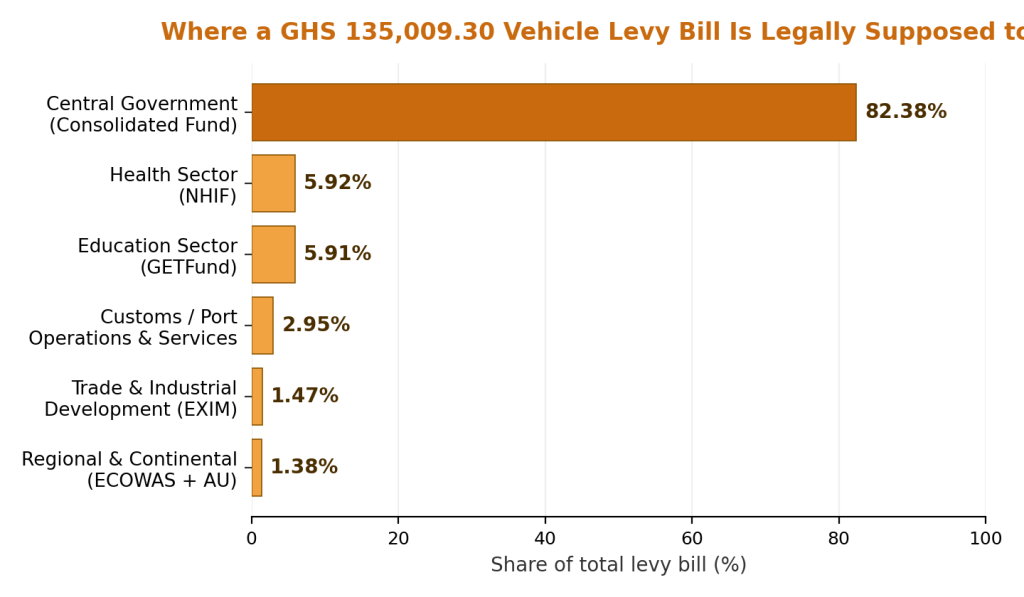
Figure 1. Share of the total levy bill assigned to each final destination, after collection by GRA.
4.3 From GRA’s till to final destination: what actually happens
Statutory earmarking is not the same as effective use. The National Health Insurance Levy is legally dedicated to the National Health Insurance Fund under Act 852, collected by GRA and intended to pay for members’ healthcare claims. But at the March 2025 National Economic Dialogue, Ghana’s Finance Minister disclosed that less than 60% of the NHIS budget was going toward claims payments, attributing the shortfall to resources being diverted toward what he called non-core activities. The government’s response, detailed in the March 2025 budget statement, was to uncap the NHIL entirely and programme GH₵9.93 billion for the scheme in 2025, later reported at roughly GH₵10.7 billion for 2025 including GH₵6.5 billion earmarked specifically for provider claims, evidence that the underlying diagnosis was taken seriously even if the full effect will take time to verify in outcomes.
The GETFund Levy appears better documented in terms of use: Act 581 specifies in detail that GRA-collected GETFund revenue is to finance academic infrastructure, scholarships, student loans and research grants, and the Fund has a long public record of large-scale tertiary infrastructure projects. The Ghana EXIM Bank Levy is, on the evidence we found, the most cleanly documented of all: Act 911 specifies that GRA collects the full 0.75% import levy monthly, retains none of it, and passes 90% directly to the Bank and 10% to the Ghana Export Promotion Authority, a split that GEXIM Bank has itself defended publicly with reference to its own transaction records when questioned by the press. On the regional side, Ghana’s own delegation to the ECOWAS Parliament reported in May 2026 that the country had paid about $82.5 million in Community Levy contributions for 2025, with GH₵908.53 million in lodgments between January and October 2025 alone, while still owing an outstanding balance of about $15.5 million (roughly GH₵170.69 million) to the ECOWAS Commission, suggesting a levy that GRA collects reliably but that government remits to ECOWAS only partially and with delay.
By contrast, the smaller administrative fees on the invoice are the hardest to verify once GRA has collected them. The GHS Disinfection Fee is charged under the general disinfection powers in the Public Health Act, 2012 (Act 851), collected by GRA and passed to the Ghana Health Service’s Port Health mandate, but we found no published report anywhere breaking down what specific disinfection activity, staffing or equipment this revenue funds nationally, nor how the GHS 143.38 charged on this vehicle compares to the actual cost of disinfecting it. The same appears true of the Network Charge and its associated VAT, which rest on ICUMS and GRA administrative fee schedules rather than a specific Act, and for which we could not locate any public accounting of how the fee relates to the underlying cost of operating the customs IT platform.
5. Discussion
Three patterns emerge from this case study. First, because GRA collects every charge through the same ICUMS transaction, the invoice conflates general taxation with earmarked levies in a way that likely misleads the ordinary importer about where their money goes; a receipt that lists NHIL and GETFund alongside Import Duty, without distinguishing statutory purpose or final recipient, invites the assumption that a much larger share of the bill is funding health and education than the 11.8% our analysis found. Second, even where earmarking is legally sound, as with NHIL, it appears to have been undermined in practice by capping rules and resource diversion, a problem the government has publicly acknowledged and only recently begun to correct through the 2025 uncapping. Third, there is a clear gap in transparency between levies created by Acts of Parliament, which at least have a documented legal purpose that can be checked against outcomes, and administrative fees set by agency circular, which in several cases (the Disinfection Fee, the Network Charge) appear to have no public cost basis at all.
The Ghana EXIM Bank Levy stands out as something of a model within this system: a codified 90/10 split, a public defense of its own transaction records when challenged, and a documented history of loan disbursement. If the government wanted a template for making the health and education levies equally legible to the public, GRA’s own collection data, paired with EXIM Bank’s disclosure practices, rather than any new legal mechanism, may be the simplest place to start. Overall, the evidence indicates a system that is legally coherent at the level of individual Acts, but poorly integrated at the level of public communication, since the single point of collection (GRA) is never made visible to the person actually paying.
6. Limitations
- This is a single-invoice case study. Exact cedi amounts and category shares will vary with a vehicle’s value, age, engine type and fuel category, so the precise percentages reported here should not be generalized to every import without further sampling across vehicle classes.
- National-level utilization figures, such as the NHIS claims-payment ratio, describe the whole scheme’s finances, not the specific cedis collected from this one vehicle, so the link between this invoice and that outcome is illustrative rather than causal.
- Several charges (the Network Charge, Vehicle Certification, the MoTI e-IDF Fee) rest on administrative fee schedules rather than an Act of Parliament, making their legal basis harder to independently verify than a statutory levy, since agency circulars are not always published in full.
- The GH₵1.31 billion in Ghana EXIM Bank loan disbursements for 2017 to 2022 is drawn from a secondary Finance Ministry review rather than GEXIM’s own audited financial statements, and we were not able to independently reconcile the figure against GEXIM’s annual reports.
- This analysis reflects rates and rules current as of the VAT Act, 2025 (Act 1151) reform effective January 2026; individual rates, caps or allocations may be revised in future budgets.
7. Recommendations
1. Publish a plain-language, itemized breakdown on the ICUMS customs platform that shows, next to every charge on a vehicle’s receipt, the Act of Parliament behind it, the fact that GRA is the collecting agency, and the agency that ultimately receives the funds. Responsible: Ghana Revenue Authority and the Ministry of Finance.
2. Hold the 2025 uncapping of the National Health Insurance Levy to its stated goal by publishing a quarterly, public claims-payment ratio for the NHIS, so the 60% shortfall the Finance Minister flagged can be tracked to closure rather than referenced once and forgotten. Responsible: National Health Insurance Authority and Ministry of Finance.
3. Release an annual, project-by-project disbursement report for the share of GETFund revenue collected specifically from vehicle and general goods imports, so importers can see the concrete infrastructure, scholarships or loans their levy contributed to. Responsible: GETFund Board of Trustees and Ministry of Education.
4. Put every ICUMS-related administrative charge, including the Network Charge, its VAT component, Vehicle Certification and similar fees, on a public fee schedule with a stated cost basis, reviewed at fixed intervals, rather than leaving them as internal GRA arrangements with no public justification. Responsible: Ghana Revenue Authority.
5. Require the Ghana Health Service to publish what its Port Health disinfection budget actually covers nationally, and how that compares with revenue GRA collects under the Disinfection Fee, so the fee’s size can be checked against real, auditable activity. Responsible: Ghana Health Service and Ministry of Health.
References
Customs Act, 2015 (Act 891).
Value Added Tax Act, 2025 (Act 1151); previously Value Added Tax Act, 2013 (Act 870). Ghana Revenue Authority, VAT guidance notice, 2026; EY, Reference Guide to the New VAT Act, 2025 (Act 1151), January 2026; Crowe Veritas, Ghana VAT Reform 2026: A Practical Guide for Businesses, 5 February 2026.
Special Import Levy Act, 2013 (Act 861), and amendments (Acts 869, 884, 944), GhaLII.
National Health Insurance Act, 2012 (Act 852), replacing the National Health Insurance Act, 2003 (Act 650); Ministry of Health and National Health Insurance Authority publications; Joint Learning Network, Earmarking in Ghana: Impacts on the Financial Sustainability of the National Health Insurance Scheme.
Ghana Education Trust Fund Act, 2000 (Act 581), amended by the Ghana Education Trust Fund (Amendment) Act, 2018 (Act 972), GhaLII.
Ghana Export-Import Bank Act, 2016 (Act 911); Export Trade, Agricultural and Industrial Development Fund Act, 2013 (Act 872); Ghana EXIM Bank, About GEXIM and FAQs; ModernGhana, Opinion: Ghana Beyond Aid, The Role of Ghana EXIM Bank.
Income Tax Act, 2015 (Act 896). Public Health Act, 2012 (Act 851). African Union Import Levy Act, 2017 (Act 952).
Ghana Shippers’ Authority Act, 2024 (Act 1122), replacing the Ghana Shippers’ Council Decree, 1974 (N.R.C.D. 254); Asaase Radio, Ghanaian Times and The Herald Ghana coverage, July 2025.
ECOWAS Treaty, Article 72 (Community Levy). U.S. International Trade Administration, Ghana Country Commercial Guide, Import Tariffs.
GhanaWeb, “Less than 60% of NHIS budget goes into claims payment, Minister of Finance”, 5 March 2025.
GBC Ghana Online, “Ghana’s economy needs urgent reforms, says Finance Minister”, 3 March 2025.
ModernGhana, “2025: Finance Minister highlights financial allocations to key initiatives”, 11 March 2025; GhanaFact, live fact-check of the 2025 budget presentation, 12 March 2025; MyJoyOnline, “Finance Ministry cites ¢10.7bn 2025 NHIS funding as health financing reforms deepen”.
Ghanamma, “Ghana Pays $82.5m ECOWAS Levy, Reaffirms Regional Integration Commitment”, 6 May 2026.
Pyrczak, F., & Tcherni-Buzzeo, M. (2019). Evaluating research in academic journals: A practical guide to realistic evaluation (7th ed.). Routledge.