



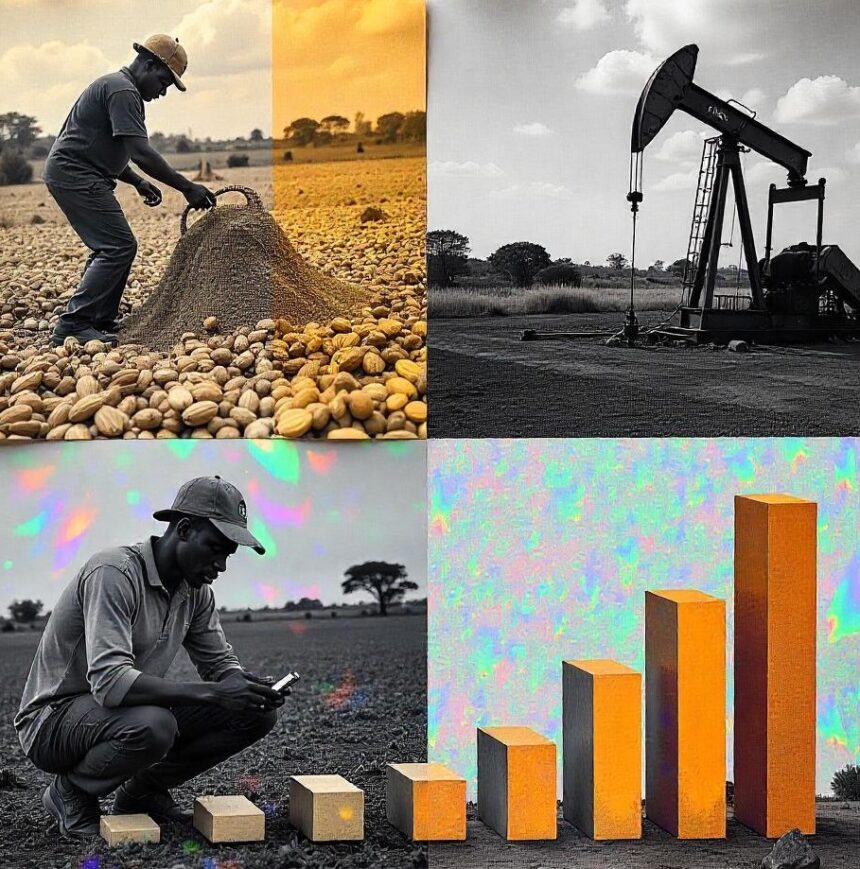
Between 2018 and 2023, remittances from the Ghanaian diaspora consistently outperformed or rivalled Ghana’s traditional foreign exchange earners; gold, cocoa, oil, and even foreign direct investment (FDI). While commodities remain central to Ghana’s export narrative, the data reveal that diaspora-driven remittances are more stable, resilient, and widely distributed. This paper compares remittances with legacy economic sectors, analyses their crisis resistance and household-level impact, and proposes policy frameworks to elevate remittances from private support to a central pillar of national economic strategy.

Introduction

Ghana’s economy has long been anchored on a trio of export pillars: gold, cocoa, and oil. More recently, foreign direct investment (FDI) has joined these as a key driver of external finance. However, an overlooked but increasingly important flow is remittances — funds sent home by Ghanaians abroad. This paper aims to evaluate the comparative performance and economic impact of remittances relative to traditional exports and capital inflows, and to recommend a shift in policy focus that reflects the emerging reality.
Methodology

Data Collection
This study uses a longitudinal dataset covering the period 2018–2022, comparing remittance inflows with earnings from gold, cocoa, oil, and FDI.
Data Sources
The analysis draws on data from the World Bank, Statista, Ghana Statistical Service, and UNCTAD.
Analysis Metrics
Metrics analyzed include annual volume, volatility, crisis-resilience, and direct economic utility.
Results: Remittances Outpace Traditional Pillars
| Year | Remittances (GHS) | Gold (GHS) | Cocoa (GHS) | Oil (GHS) | FDI (GHS) |
| 2018 | 16.9 billion | 8.5 billion | 3.2 billion | 10.3 billion | 14.4 billion |
| 2019 | 21.1 billion | 9.8 billion | 3.2 billion | 10.3 billion | 20.2 billion |
| 2020 | 24.0 billion | 8.2 billion | 3.5 billion | 11.8 billion | 10.5 billion |
| 2021 | 11.1 billion | 7.4 billion | 3.1 billion | 12.5 billion | 14.7 billion |
| 2022 | 17.4 billion | 7.9 billion | 3.0 billion | 13.0 billion | 12.0 billion |
| 2023 | 27.2 billion | 8.6 billion | 3.1 billion | 10.3 billion | 14.8 billion |
In 2020, during the COVID-19 pandemic, remittances reached GHS 24 billion, nearly triple the value of cocoa exports and far exceeding gold earnings. This underscores remittances’ consistency during periods of economic uncertainty.
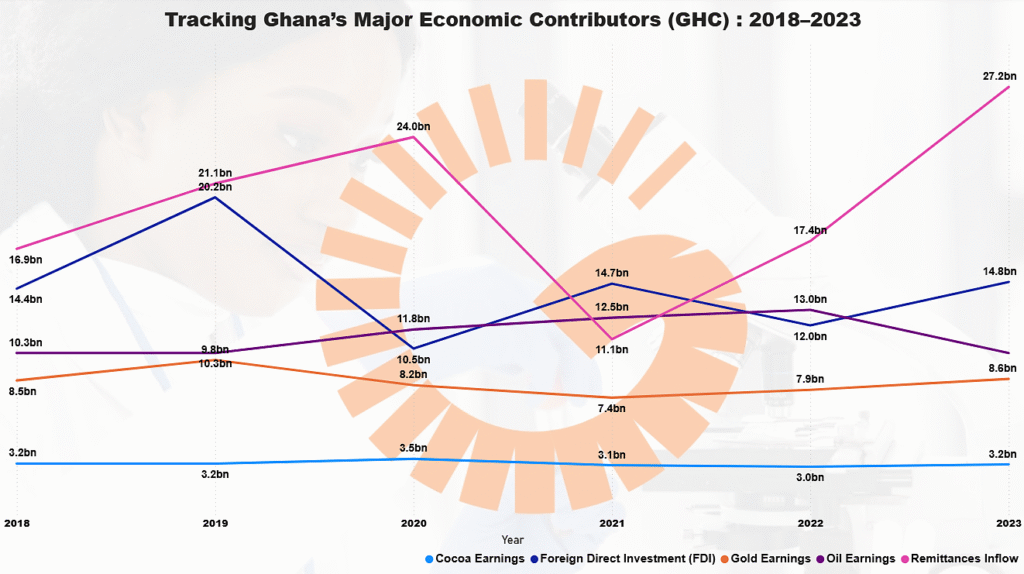
Between 2018 and 2023, remittance inflows to Ghana showed strong growth, rising significantly from ₵16.9 billion in 2018 to ₵27.2 billion in 2023, making it the most consistently increasing contributor among the five categories. Gold earnings fluctuated slightly but remained within the ₵7.4–9.8 billion range, while cocoa earnings stayed relatively flat, averaging around ₵3.1 billion, indicating limited growth in the sector. Oil earnings peaked in 2022 at ₵13 billion but dropped to ₵10.25 billion in 2023, matching 2018 levels and suggesting performance challenges. FDI showed a spike in 2019 (₵20.2 billion) but experienced volatility in subsequent years, recovering to ₵14.8 billion in 2023 after a dip in 2020. Overall, remittances stand out as the most reliable and growing inflow, while the other sectors display mixed or stagnant performance trends.

Comparative Analysis
Gold & Cocoa
- Highly volatile market dependency
- High government revenue share
- Minimal household impact
- Often declines during crises
Remittances
- Stable and need-driven
- Low government revenue share (but can be taxed/invested)
- High and direct household impact
- Often increases during crises
Policy Implications: Rethinking Ghana’s Economic Strategy
Policy Recognition
Classify remittances as strategic economic exports in national development plans
Investment Pathways
Channel remittances into productive sectors through diaspora funds and impact investment vehicles
Diaspora Engagement
Empower the diaspora as economic actors via structured incentives, reduced transaction costs, and regulatory protections
Conclusion
Traditional Resources
Gold may shine and cocoa may sweeten Ghana’s brand abroad, but they are subject to market volatility and external factors
Remittance Impact
Remittances consistently fuel household survival and resilience with direct benefits to education, healthcare, and small businesses
Strategic Shift
Ghana must transition from viewing remittances as private acts of charity to strategic capital flows
Future Outlook
As the country looks toward inclusive and stable growth, the most valuable resource may not be what lies beneath the soil, but who lives beyond its borders